🖊️ Bloom’s Taxonomy and Its Influence on Writing Learning Objectives
Bloom’s Taxonomy is one of the most influential frameworks in education and talent development because it provides a structured way to describe learning outcomes. Rather than focusing on what content is covered, Bloom’s Taxonomy focuses on what learners are able to do as a result of instruction. This distinction is critical when writing effective learning objectives.
Before Bloom’s work, objectives were often vague and difficult to measure. Statements such as “learners will understand the process” or “be familiar with the system” offered little guidance for instruction or assessment. Bloom’s Taxonomy addressed this problem by categorizing learning according to observable cognitive behaviors and pairing those behaviors with action-oriented language.
What Bloom’s Taxonomy Is
Bloom’s Taxonomy is a classification system for learning in the cognitive domain. It organizes learning into levels that represent increasing complexity in how learners engage with information. These levels describe types of thinking, not content difficulty, and they clarify what learners are expected to demonstrate at the end of instruction.
In its revised form, the taxonomy defines six levels of cognitive learning: remembering, understanding, applying, analyzing, evaluating, and creating. Each level reflects a distinct way learners interact with knowledge, from basic recall to generating new ideas or solutions.
Levels of Learning in Bloom’s Taxonomy
The chart below explains what each level represents and how learner behavior changes as cognitive complexity increases. Click the levels below to learn more about each one.
-
What the Learner Is Doing
Retrieving information
Description
Recalling facts, terms, or basic concepts without interpreting them
-
What the Learner Is Doing
Constructing meaning
Description
Explaining ideas or concepts in one’s own words
-
What the Learner Is Doing
Using knowledge
Description
Carrying out a procedure or using information in a new situation
-
What the Learner Is Doing
Examining relationships
Description
Breaking information into parts to understand structure or cause-and-effect
-
What the Learner Is Doing
Making judgments
Description
Assessing ideas or solutions using criteria or standards
-
What the Learner Is Doing
Producing something new
Description
Combining elements to form a new structure, plan, or solution
These levels are not steps that every lesson must follow. Instead, they help learning professionals intentionally choose the depth of learning required for a specific objective.
How Bloom’s Verbs Work
The verbs associated with Bloom’s Taxonomy are not decorative language. Each verb signals a specific type of cognitive behavior and clarifies how learning will be demonstrated. This is why Bloom’s Taxonomy is so influential in objective writing: verbs make learning outcomes observable.
A verb like identify signals recall, while a verb like analyze signals examination of relationships. Choosing the correct verb ensures that objectives, instruction, and assessment are aligned.
The table below provides commonly used Bloom’s verbs grouped by cognitive level. This table is best used as a reference, not a checklist.
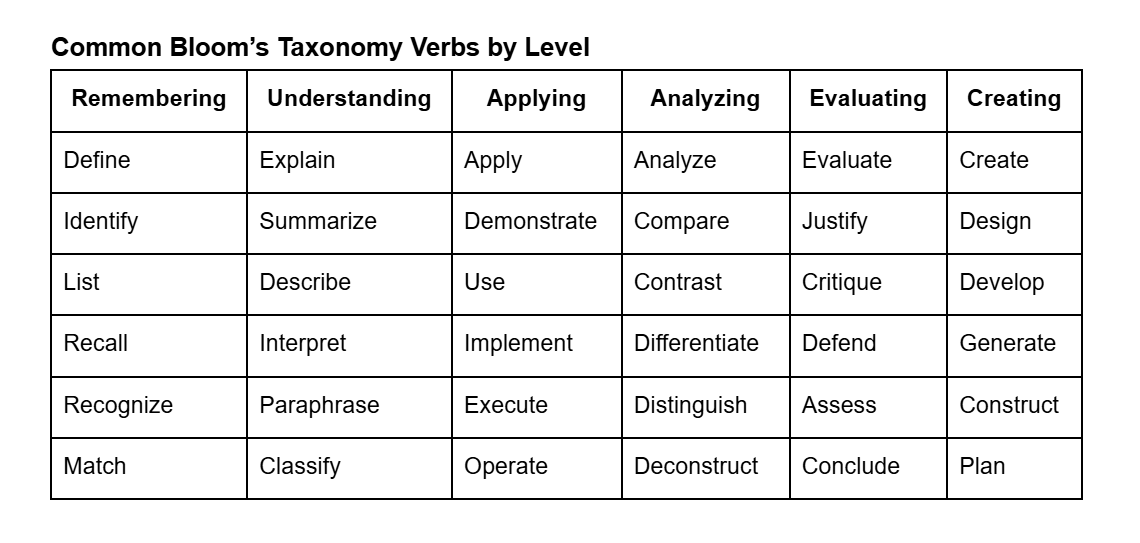
Not every verb will fit every context. The key is selecting a verb that accurately reflects the performance you expect learners to demonstrate.
Bloom’s Taxonomy and Writing Learning Objectives
Bloom’s Taxonomy directly influences how learning objectives are written by shifting the focus from internal understanding to observable behavior. Effective objectives describe what learners will do, not what they will know or feel.
EXAMPLE 1
A weak objective often relies on vague language:
Learners will understand the change management process.
This objective does not specify how understanding will be demonstrated, making it difficult to design instruction or assessment.
A stronger objective uses an intentional Bloom’s verb:
Learners will analyze a change management case study to identify sources of employee resistance.
Here, the verb analyze clarifies the level of thinking required, while the task defines what successful performance looks like.
EXAMPLE 2
Another common example of a weak objective is:
Learners will be familiar with the reporting system.
This objective describes exposure rather than capability. A Bloom-aligned alternative would be:
Learners will generate a standard performance report using the reporting system.
This version clearly communicates expectations and supports meaningful assessment.
Why This Matters in Practice
When objectives are written using Bloom’s Taxonomy, instructional design becomes more intentional. Learning activities can be selected to match the level of thinking required, and assessments can be designed to collect valid evidence of learning.
Misalignment often occurs when objectives target higher-level thinking but instruction and assessment focus on recall. Bloom’s Taxonomy helps prevent this by making expectations explicit at the objective level, where all instructional decisions begin.
Conclusion
Bloom’s Taxonomy remains a foundational framework because it brings clarity to learning design. By defining levels of cognitive learning and pairing them with purposeful action verbs, the taxonomy enables learning professionals to write objectives that are measurable, aligned, and instructionally meaningful.
When used correctly, Bloom’s Taxonomy is not about making learning sound complex. It is about clearly defining what learning looks like and ensuring that instruction and assessment support that goal.