

Technician Competency Framework & Career Progression
I designed and implemented a system that defines performance and became the foundation for how technicians are trained and developed.
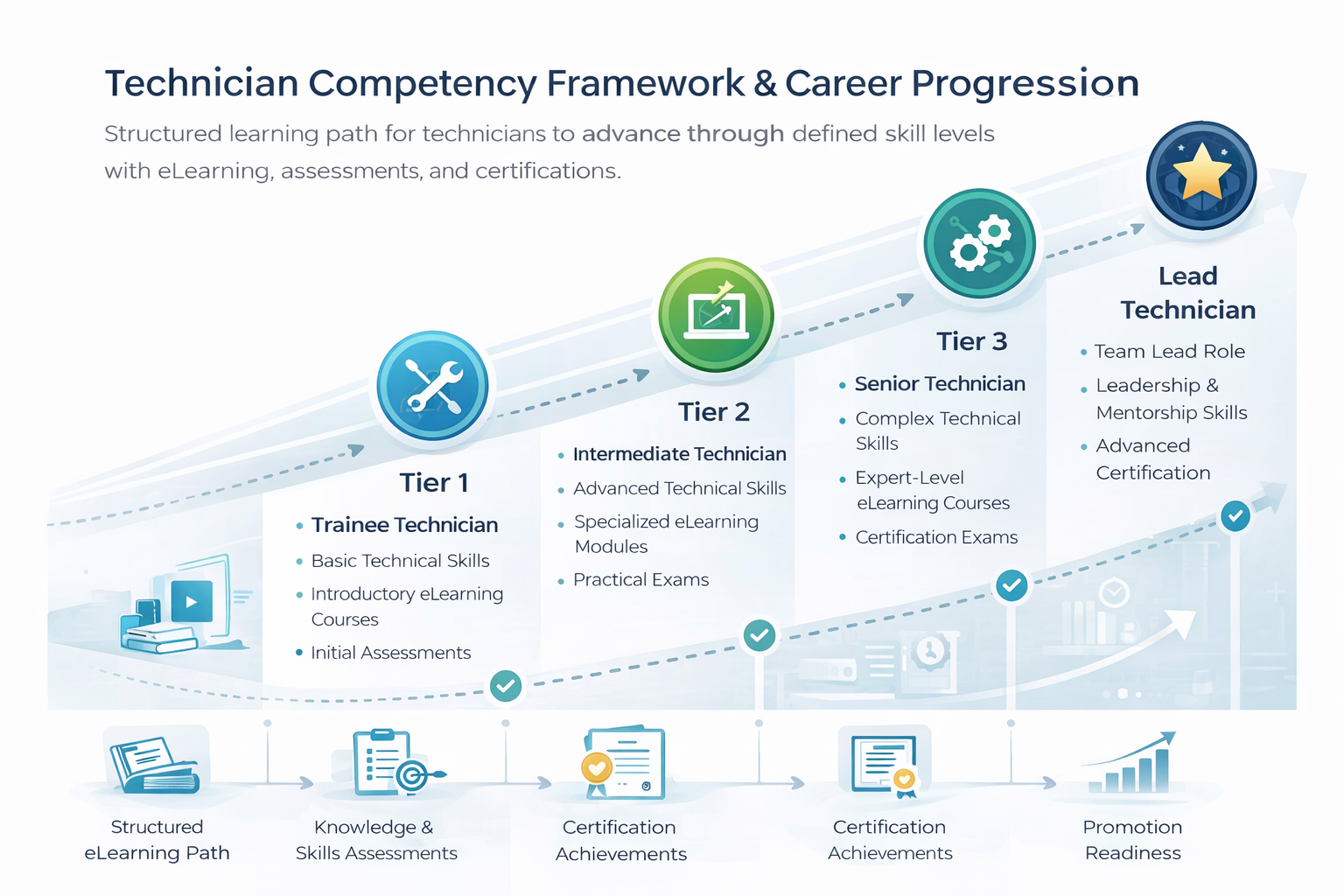
Framework Overview
This model illustrates the structured progression from Tier 1 to Lead Technician, supported by eLearning, assessments, and certification milestones that validate readiness at each stage.
Introduction
Technician training was inconsistent, expectations were unclear, and advancement decisions relied heavily on subjective judgment rather than defined criteria.
To address this, I designed a technician competency framework that defined skill levels, aligned training to real-world performance, and created a clear progression path from Tier 1 to Lead Technician supported by structured learning and validation.
Impact
Standardized technician skill expectations across levels
Created a clear progression path from Tier 1 to Lead
Connected training, validation, and promotion criteria
Supported more objective advancement decisions
Established a scalable workforce development model
Project Overview
Project Type: Workforce Development, Competency Framework, Career Progression, Training Strategy, Assessment Design, LMS-Enabled Learning
Tools / Systems: Docebo LMS, eLearning, quizzes, knowledge checks, exams, certification logic, documentation systems
The Challenge
Before this work, technician development depended too heavily on inconsistent live instruction, uneven documentation, and varying interpretations of what technicians needed to know at each level. That made it difficult to train consistently, identify knowledge gaps, and determine when someone was truly ready for advancement.
There was a need for a structured model that could define expectations, guide training, and support measurable progression. That need is consistent with the technician onboarding, knowledge-gap, KPI, and documentation themes reflected in your uploaded Micrologic summary.
My Role
I led the design of the framework and connected it to the broader training ecosystem. This included defining progression levels, identifying required knowledge areas, aligning learning assets to skill expectations, and supporting validation through assessments and certification-style checkpoints.
The Solution
I designed and implemented a structured framework mapping technician growth across four levels: Tier 1, Tier 2, Tier 3, and Lead.
Each level defined:
required technical skills
aligned training content
validation through assessments and certification
expectations tied directly to real-world job performance
The framework was built as a system, connecting onboarding, eLearning, knowledge gap training, and promotion readiness into a unified progression model.
This established a shared definition of performance across technicians, training, and leadership.
How It Worked
1. Defined competency levels
I established clear expectations for each technician level so progression was no longer vague or informal.
2. Aligned training to progression
Training content was mapped to the knowledge and skills technicians needed at each stage, creating a more intentional learning path.
3. Added validation points
I incorporated quizzes, knowledge checks, exams, performance tests, and promotion-aligned assessments so advancement could be supported by measurable criteria rather than opinion alone.
4. Connected the framework to the learning ecosystem
Because Micrologic University was being developed as the central LMS environment, the framework could be supported through structured learning paths, reporting, and certification logic. Your uploaded summary specifically notes branch structures, user groups, learning paths, reporting, and certification structure within the LMS.
Results
Established a clear, standardized progression model across technician roles
Reduced ambiguity in training expectations and advancement decisions
Improved alignment between training and real-world job performance
Enabled more consistent evaluation of technician readiness
Created a scalable foundation for onboarding, upskilling, and promotion
Increased onboarding satisfaction scores from approximately 3.0 to 4.5 stars, with feedback highlighting improved clarity, structure, and overall learning experience
Knowledge Gap training series achieved 4.5-star ratings in its initial release, with strong feedback on effectiveness and learning experience
Why This Matters
This project reflects my approach to learning design beyond course creation. I focus on building systems that define performance, enable growth, and connect training directly to real-world outcomes.
This framework established a shared definition of performance across technicians, training, and leadership, and became the foundation for onboarding, training, assessment, and technician development across the organization.