

Technician Onboarding Transformation
I redesigned technician onboarding from an inconsistent, SME-dependent process into a structured learning experience that improved clarity, consistency, and readiness from day one.
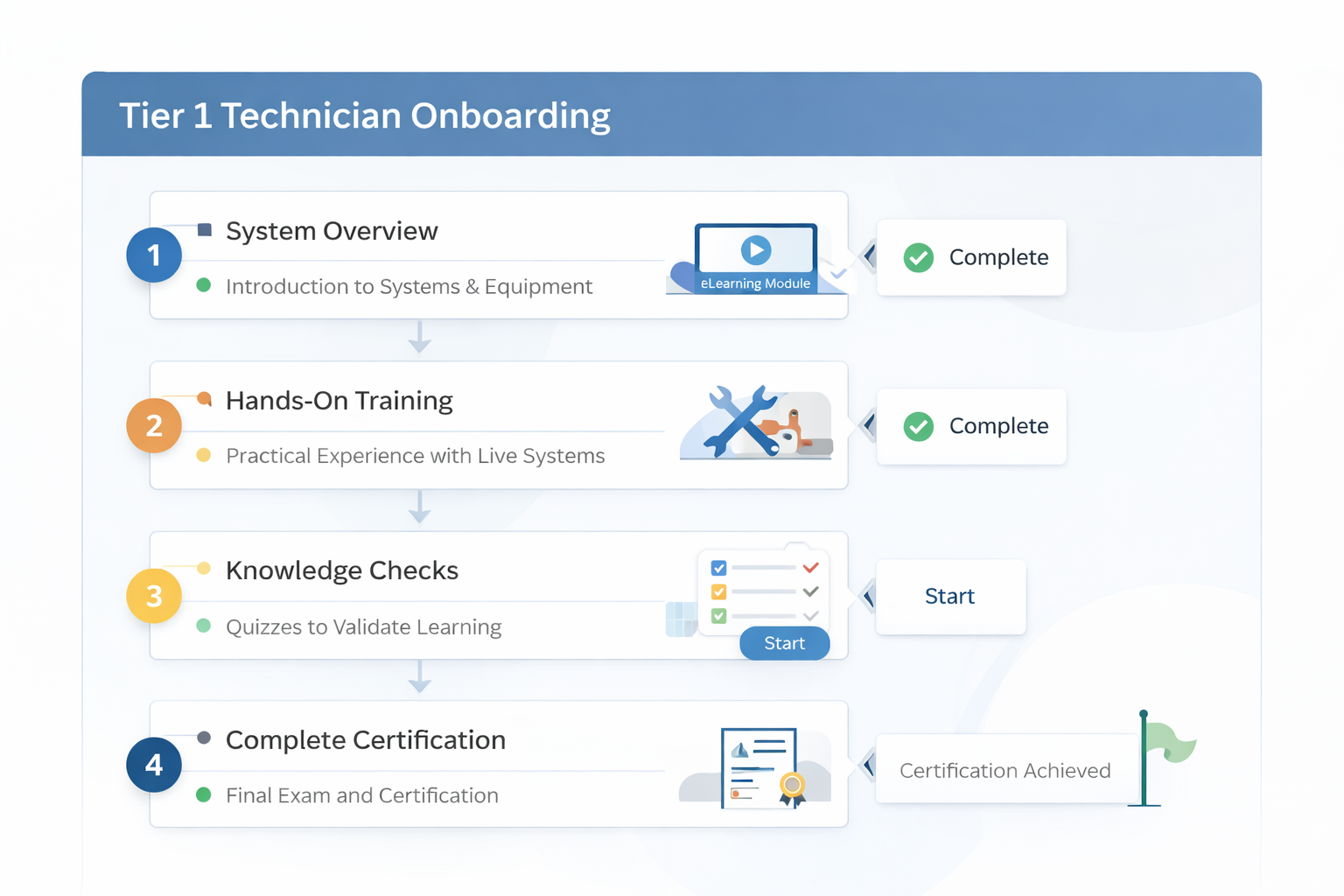
Onboarding Path Overview
This model illustrates how technician onboarding was redesigned into a structured path combining eLearning, hands-on training, validation, and certification to support faster ramp-up and more consistent early performance.
Introduction
Technician onboarding relied too heavily on live, SME-led instruction, which made the experience inconsistent, difficult to scale, and heavily dependent on who was training. New technicians often received uneven guidance, struggled with clarity, and had limited structure for building foundational knowledge.
To address this, I redesigned onboarding into a guided learning path supported by eLearning, hands-on application, knowledge checks, and certification milestones. The goal was to create a more structured, repeatable experience that reduced confusion and better prepared technicians for real-world work.
Impact
Increased onboarding satisfaction scores from approximately 3.0 to 4.5 stars, with feedback highlighting improved clarity, structure, and usability
Significantly reduced ramp-up time for new technicians
Improved consistency of onboarding across locations
Reduced reliance on SMEs for day-to-day training
Project Overview
Project Type: Onboarding Design, Workforce Development, eLearning Strategy, Learning Path Design, Blended Learning, Assessment Design
Tools / Systems: Docebo LMS, eLearning, guided learning paths, knowledge checks, quizzes, certification milestones, documentation systems
The Challenge
Before this redesign, onboarding lacked structure and consistency. Because the experience depended so heavily on live training from SMEs, delivery varied widely and foundational knowledge was not always taught in a clear or repeatable way. That led to confusion, uneven onboarding experiences, and slower readiness for the job.
There was a need for a more scalable model that could guide technicians through essential learning in a way that was structured, engaging, and easier to support across locations.
My Role
I led the redesign of the onboarding experience and connected it to the broader technician development system. This included identifying early-stage learning needs, structuring the onboarding path, aligning content to job expectations, designing interactive learning experiences, and incorporating validation points to support readiness.
The Solution
I redesigned onboarding as a guided, multi-step learning experience that combined foundational eLearning, hands-on practice, knowledge validation, and certification into a more intentional path for new technicians.
The onboarding path was structured to include:
system and equipment overview
guided eLearning modules
hands-on training with live systems
quizzes and knowledge checks
final validation and certification milestones
The result was a more scalable onboarding system that improved clarity, consistency, and early performance.
This transformed onboarding from a trainer-dependent process into a structured, scalable system.
How It Worked
1. Built a clearer starting point
I created a more structured introduction to systems, equipment, and core workflows so new technicians could begin with a stronger foundation.
2. Added guided eLearning
I developed eLearning experiences that helped standardize foundational learning and reduce variation in how key information was introduced.
3. Blended learning with hands-on practice
Rather than relying only on live instruction, the onboarding experience combined digital learning with practical application to support both clarity and real-world readiness.
4. Introduced validation points
I incorporated quizzes, knowledge checks, and certification milestones so readiness could be supported by measurable progress rather than informal judgment alone.
5. Improved scalability across locations
Because the onboarding path was more structured and repeatable, it became easier to deliver consistently across teams and environments.
Results
Improved technician confidence and early performance through clearer structure and guided learning
Reduced confusion and learner frustration associated with unstructured live training
Increased onboarding satisfaction from approximately 3.0 to 4.5 stars
Received strong feedback praising the clarity of the experience and effectiveness of interactive learning elements
Why This Matters
This project reflects my approach to onboarding as more than orientation or early training. I focus on designing structured systems that help people build confidence, gain clarity, and become effective more quickly.
This onboarding transformation became a practical example of how learning design can reduce confusion, improve consistency, and create a stronger bridge between training and job performance.
This onboarding model aligned directly with the technician competency framework, ensuring training, validation, and progression worked together as a unified system.