Social Learning Theory: What It Is and How to Apply It
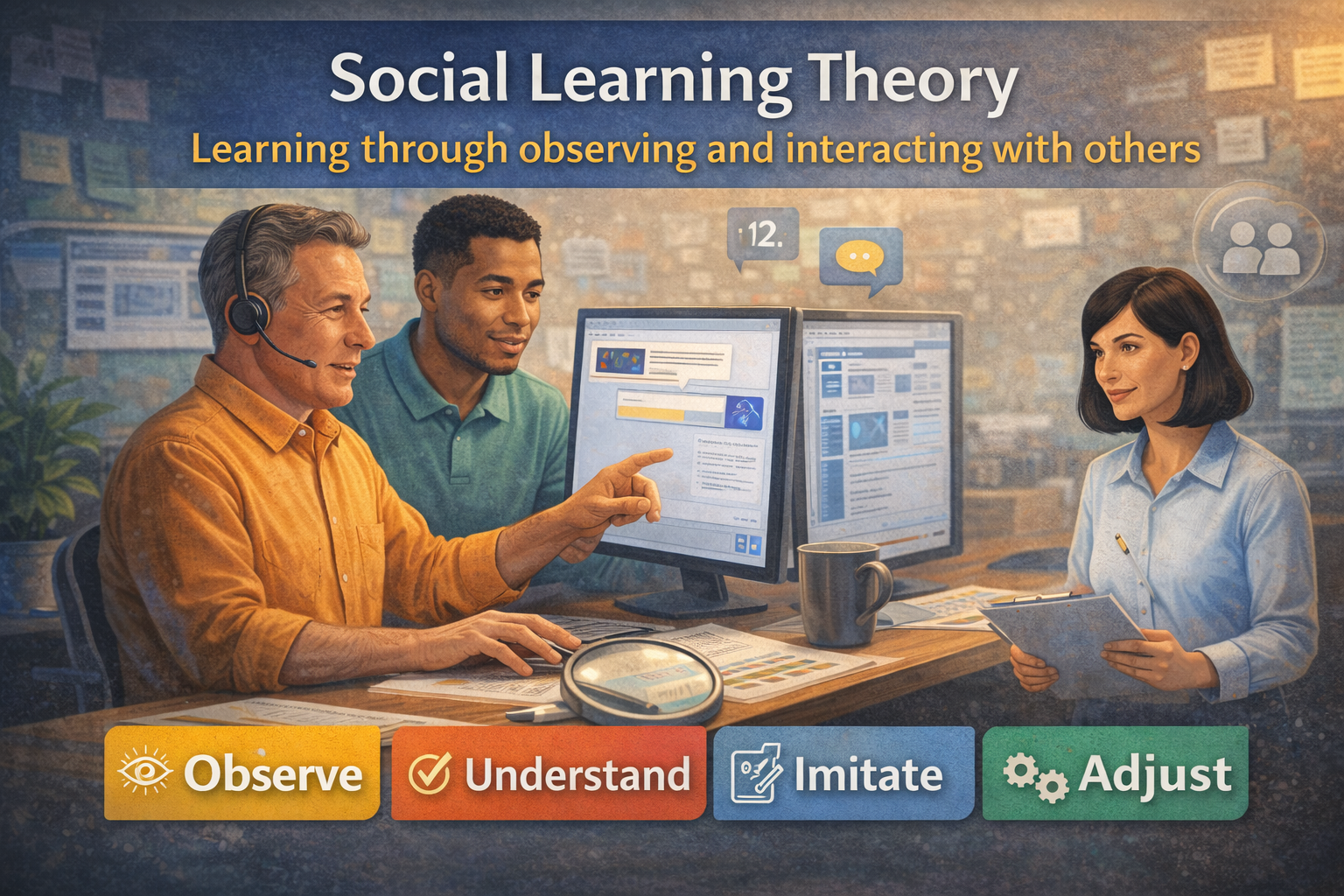
When people think about learning, they often picture courses, content, or instruction. But in reality, a large portion of learning happens naturally—through observing others, interacting with peers, and picking up behaviors in context.
That’s the foundation of Social Learning Theory.
What Is Social Learning Theory?
Social Learning Theory, developed by Albert Bandura, explains that people learn by observing others, modeling behavior, and understanding the outcomes of those behaviors.
In simple terms:
People don’t just learn from instruction—they learn from each other.
This means learning can occur when someone watches how a task is performed, listens to how someone communicates, or sees the results of a particular action. Over time, they begin to adjust their own behavior based on what they observe.
The Core Idea
At its core, Social Learning Theory describes a process that happens continuously in real environments. People observe what others are doing, make sense of it, attempt to replicate it, and then refine their approach based on feedback or results.
This process is not limited to formal training—it happens organically in day-to-day work.
What This Looks Like in the Real World
In workplace settings, Social Learning Theory shows up in ways that often feel informal but are highly effective.
For example, a new employee may learn how to handle a support call by watching an experienced technician. A team member might improve their communication style by observing how a manager interacts with clients. In many cases, employees refine their workflows simply by collaborating with peers.
None of these situations require structured training, yet they result in meaningful learning.
Why Social Learning Matters in L&D
Many training programs focus heavily on delivering information, but they don’t always reflect how people actually develop skills.
Social Learning Theory is important because it acknowledges that learning is influenced by environment and interaction. When people see real examples, engage with others, and receive feedback, they are more likely to understand and retain what they learn.
This approach is especially valuable in areas such as leadership development, communication skills, customer interactions, and technical troubleshooting—where behavior and judgment matter as much as knowledge.
How to Apply Social Learning Theory
You don’t need to completely redesign your programs to incorporate Social Learning Theory. Instead, you can intentionally create opportunities for learners to observe, interact, and practice together.
One way to do this is by using real examples and modeling. Showing how tasks are actually performed—through recorded calls, walkthroughs, or realistic scenarios—helps learners understand what success looks like.
It’s also important to incorporate observation into the learning experience. Allowing learners to watch others before attempting a task themselves builds confidence and reduces uncertainty.
In addition, creating opportunities for interaction can significantly improve learning outcomes. Group discussions, peer feedback, and collaborative problem-solving all encourage learners to engage more deeply with the material.
After observation and interaction, learners should be given the opportunity to practice and receive feedback. This can be done through scenarios, guided exercises, or coaching conversations that help reinforce the desired behavior.
Finally, learning should be supported beyond the training itself. Ongoing collaboration, access to experienced peers, and communication channels can help ensure that learning continues in the workplace.
Social Learning vs. Connectivism (Important Distinction)
Social Learning Theory and Connectivism are often grouped together because they both involve learning through others, but they are fundamentally different.
Social Learning Theory focuses on people and behavior. It emphasizes learning through observation, imitation, and interaction. In this context, learning happens when individuals watch others and adjust their behavior accordingly.
Connectivism, on the other hand, focuses on networks and access to information. It highlights the importance of connecting to the right sources of knowledge, including digital systems, communities, and information networks.
A simple way to think about the difference is this:
Social Learning is about learning through people and interaction
Connectivism is about learning through networks and information
Understanding both is important. Social Learning helps you design experiences that develop behavior, while Connectivism helps you design systems that support learning at scale.
Where Social Learning Fits in Your Design Approach
Social Learning Theory does not replace structured instructional design—it enhances it.
For example, you might use Merrill’s Principles to ensure that learning is grounded in real-world application, Mayer’s Principles to present content effectively, and ARCS to maintain engagement. Social Learning then adds another layer by encouraging interaction, reinforcing behavior through observation, and supporting learning beyond the course.
📚 Final Thought
If there’s one idea to take away, it’s this:
People don’t just learn from content—they learn from each other.
When you design with Social Learning in mind, you move beyond delivering information and begin creating environments where learning continues through real work, real interactions, and real experience.