Why Merrill’s Principles Matter
Many training programs fall short because they focus too heavily on delivering information rather than developing performance. They may explain concepts clearly, but they don’t give learners enough opportunity to practice or apply what they’ve learned.
Merrill’s principles address this gap by ensuring that instruction is:
grounded in real tasks
supported by clear examples
reinforced through practice
connected to real-world application
This approach leads to more meaningful learning and better outcomes.
What Are Merrill’s Principles of Instruction?
Developed by M. David Merrill, Merrill’s Principles of Instruction is a task-centered model that describes how learning experiences should be designed to support real performance—not just knowledge acquisition.
Rather than focusing on content delivery, this model emphasizes guiding learners through a sequence that mirrors how skills are actually developed in the real world.
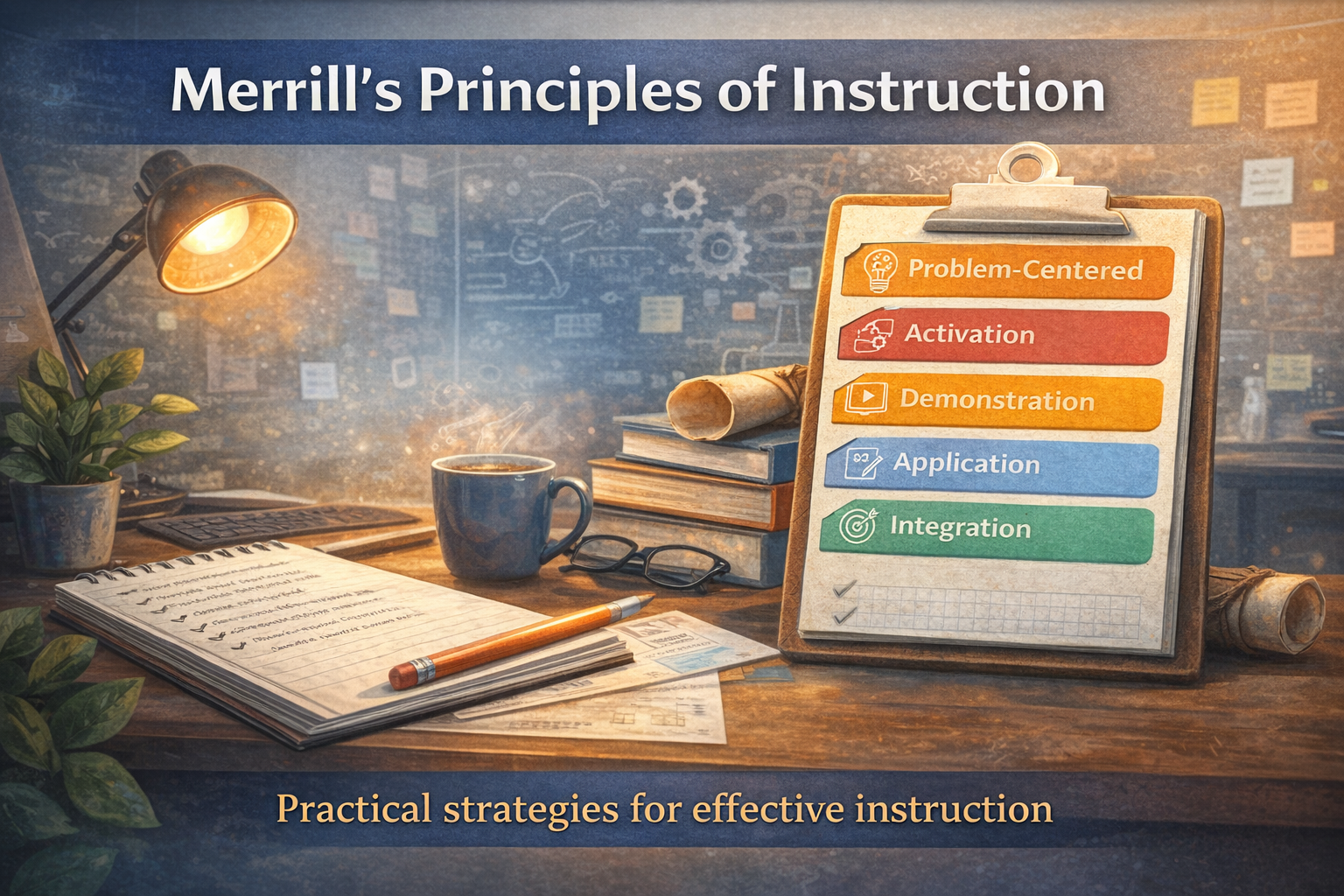
It consists of five core principles:
1. Task-Centered (Problem-Based)
2. Activation
3. Demonstration
4. Application
5. Integration
1. Task-Centered (Problem-Based)
Learning is most effective when it is organized around real-world tasks or problems, not abstract topics.
Instead of teaching isolated concepts, instruction should place learners in meaningful situations they are likely to encounter on the job. These tasks should progress from simple to complex, allowing learners to build competence over time.
This principle sets the foundation—everything else supports the learner’s ability to perform the task.
2. Activation
Before introducing new content, learners should activate relevant prior knowledge or experience.
This helps learners:
connect new information to what they already know
build on existing mental models
reduce cognitive overload
Activation can include recalling past experiences, answering questions, or reviewing similar scenarios. Without it, new learning often feels disconnected and harder to retain.
3. Demonstration
New knowledge or skills must be clearly demonstrated by the instruction—not the learner.
This is one of the most commonly misunderstood principles. Demonstration is about showing what effective performance looks like before asking learners to attempt it.
Strong demonstrations:
model the exact process or behavior
provide context through realistic scenarios
explain decision-making, not just steps
highlight what success looks like
Without clear demonstration, learners are forced to guess how to perform, which weakens the effectiveness of practice.
4. Application
Learners must actively practice and apply what they’ve learned.
This is where the learner takes action—solving problems, completing tasks, or making decisions based on the demonstrated process.
Effective application includes:
realistic practice aligned to the task
opportunities to make mistakes and improve
feedback that reinforces correct performance
Application is where learning starts to solidify into skill.
5. Integration
Finally, learners should integrate new knowledge into their real-world work or life.
This goes beyond practice—it’s about:
applying skills in real or simulated environments
reflecting on what was learned
adapting knowledge to different situations
Integration ensures that learning transfers beyond the training environment and becomes part of the learner’s actual performance.
Why This Structure Matters
These principles are not standalone—they work as a sequence:
Start with a real task
Connect to prior knowledge
Show how it’s done
Let learners practice
Support real-world use
When any of these steps are skipped or unclear, learning becomes less effective. But when applied together, they create a structured path from understanding to performance.
A Simple Example
Imagine you’re designing training on resolving a failed transaction.
You would begin with a realistic scenario where a transaction does not go through. Then, you would prompt the learner to recall any similar troubleshooting experience. After that, you would demonstrate the correct steps in the system, followed by a practice activity where the learner resolves a similar issue. Finally, you would encourage the learner to apply this process in a real or simulated work environment.
Where This Fits in Your Design Process
Merrill’s Principles don’t replace instructional design models—they complement them.
You might use ADDIE or SAM to guide your overall process, while using Merrill’s principles to ensure the instruction itself is effective. Similarly, Mayer’s principles can help refine how content is presented, and ARCS can help maintain learner engagement.
Merrill sits at the center of these, ensuring that everything ultimately supports real performance.
📚 Final Thought
If there’s one idea to take away, it’s this:
People don’t learn by consuming content. They learn by solving problems, practicing skills, and applying what they’ve learned in real situations.
That’s what Merrill’s Principles of Instruction are designed to support—and when applied well, they can transform training into something that truly drives performance.
Explore More Articles