Agile Learning Development: A Modern Approach to Building Learning in Fast-Changing Organizations
For many years, learning and development teams operated in relatively stable environments. Processes changed slowly. Systems remained consistent for long periods of time. Training programs were often developed over several months, launched once, and updated only occasionally afterward.
That world has changed.
Today, organizations evolve rapidly. Software platforms release updates constantly. Teams restructure. Workflows shift. Learners expect immediate support and accessible information exactly when they need it. In many industries, especially technology-driven environments, traditional approaches to learning development struggle to keep pace with operational reality.
This shift has led many organizations toward Agile learning development.
Agile learning development is not simply a trend or a buzzword borrowed from software development. It reflects a larger transformation in how learning experiences are designed, developed, delivered, and improved in modern workplaces. Rather than treating training as a fixed product created through long sequential phases, Agile learning development treats learning as an evolving system that grows and improves continuously over time.
Understanding this approach has become increasingly important for Talent Development and Learning & Development professionals, particularly those working in:
SaaS
customer enablement
onboarding
operations training
technical learning
leadership development
fast-moving business environments
Understanding the Foundation of Agile Learning Development
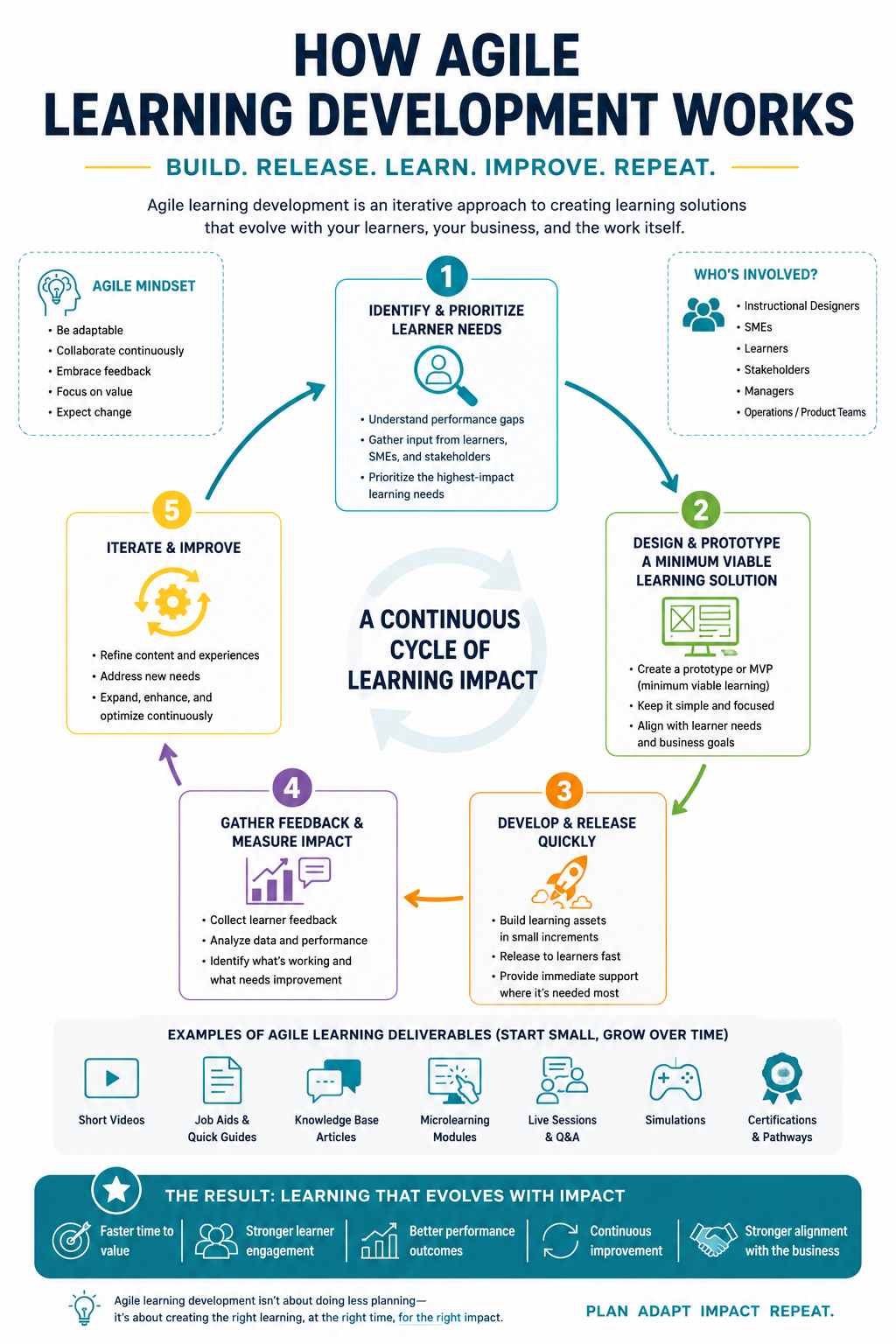
At its core, Agile learning development is an iterative and adaptive approach to creating learning experiences. Instead of attempting to fully design and perfect an entire training program before learners ever interact with it, Agile focuses on delivering learning in smaller stages, gathering feedback early, and continuously refining the experience over time.
This represents a major philosophical shift in how learning is viewed.
In traditional development models, training is often treated as a final deliverable. A team conducts analysis, develops the content, reviews the materials, launches the course, and considers the project complete.
Agile learning development approaches training differently. Learning is viewed as something dynamic — something that should continuously evolve alongside the business, the learners, and the operational environment itself.
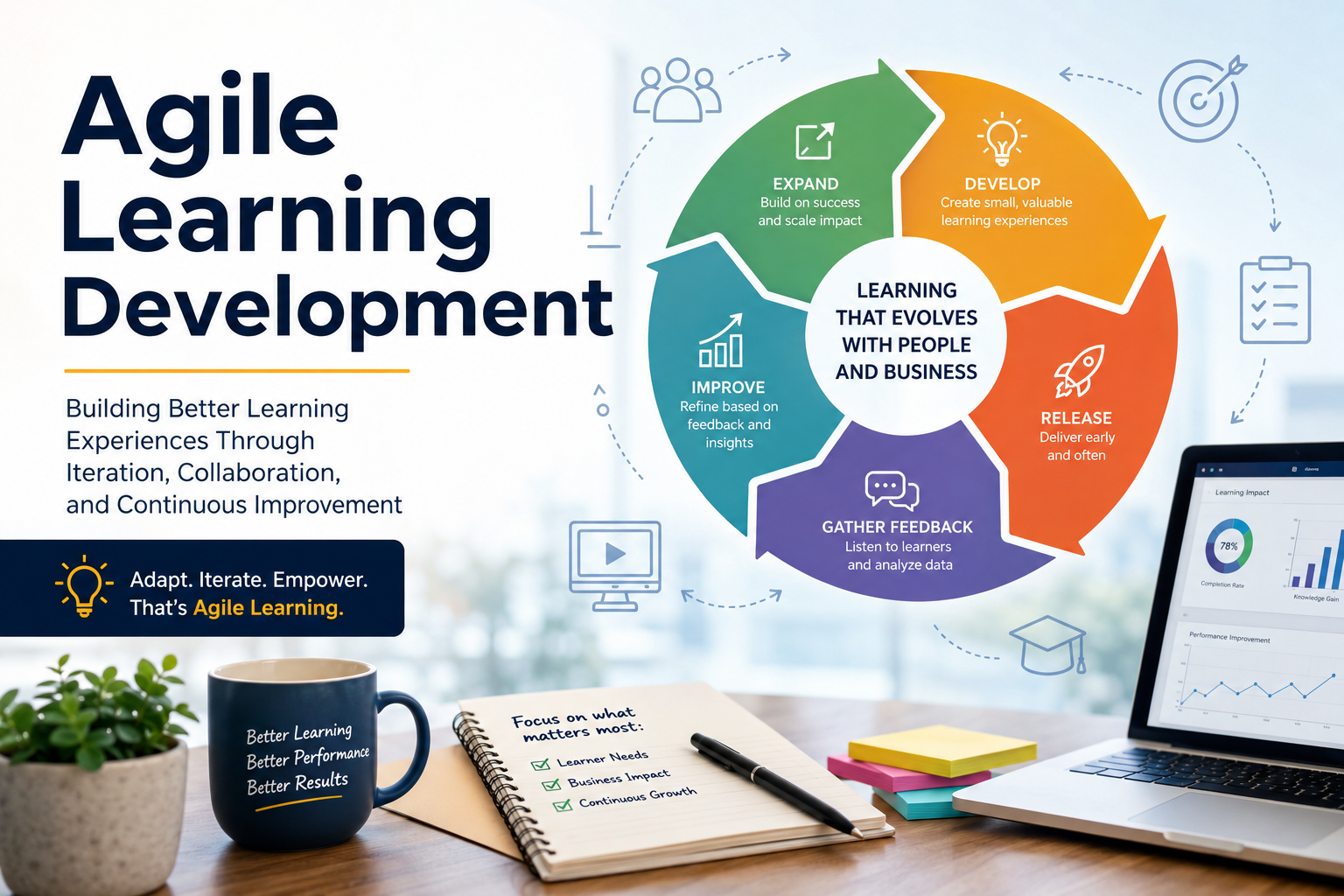
This creates a cycle of continuous improvement:
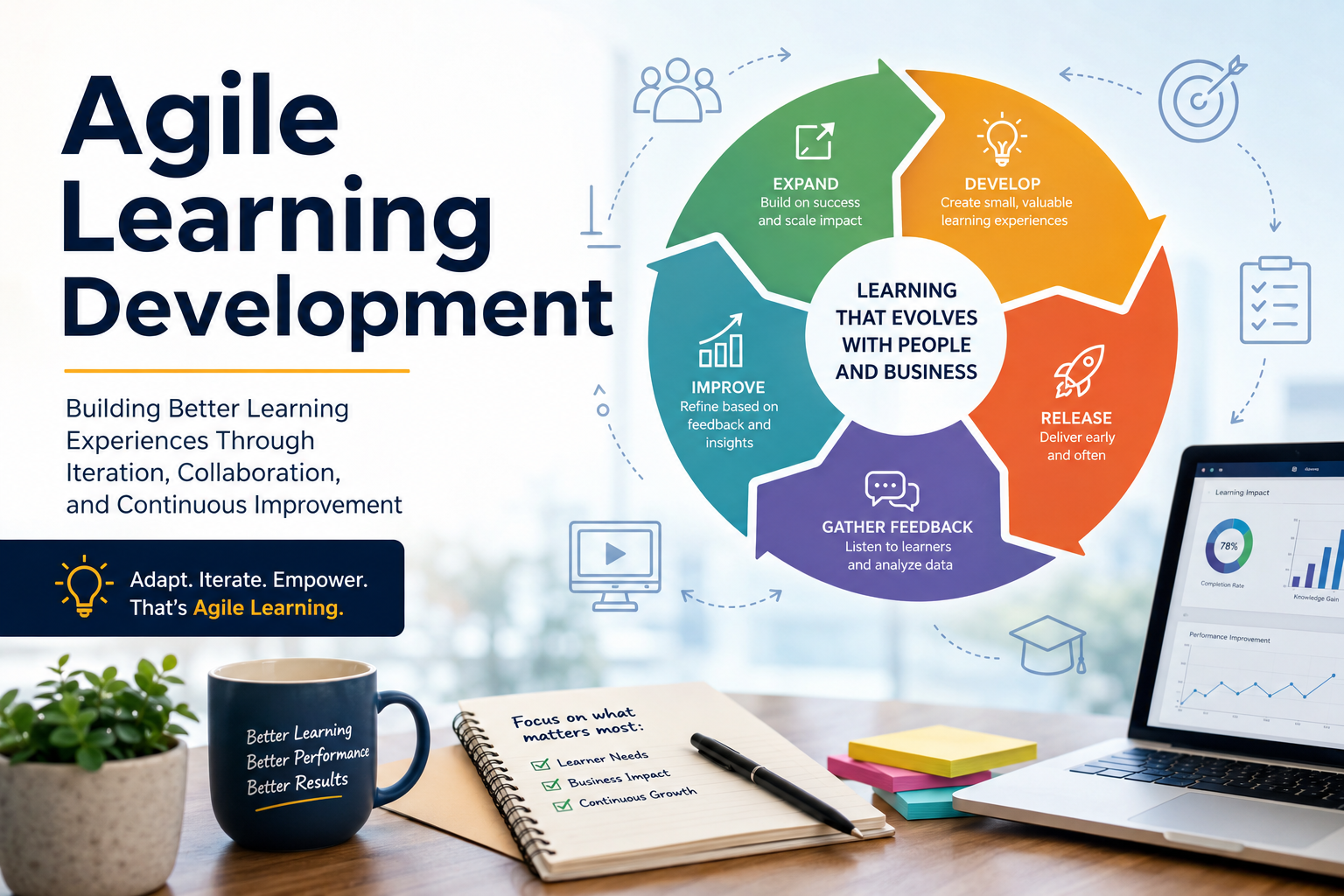
Develop → Release → Gather Feedback → Improve → Expand
Rather than waiting months to release a polished “final” product, Agile teams prioritize delivering immediate value while refining the learning experience through ongoing iteration.
The goal is not perfection before launch. The goal is responsiveness, adaptability, and continuous learner support.
Why Traditional Development Models Often Struggle in Modern Organizations
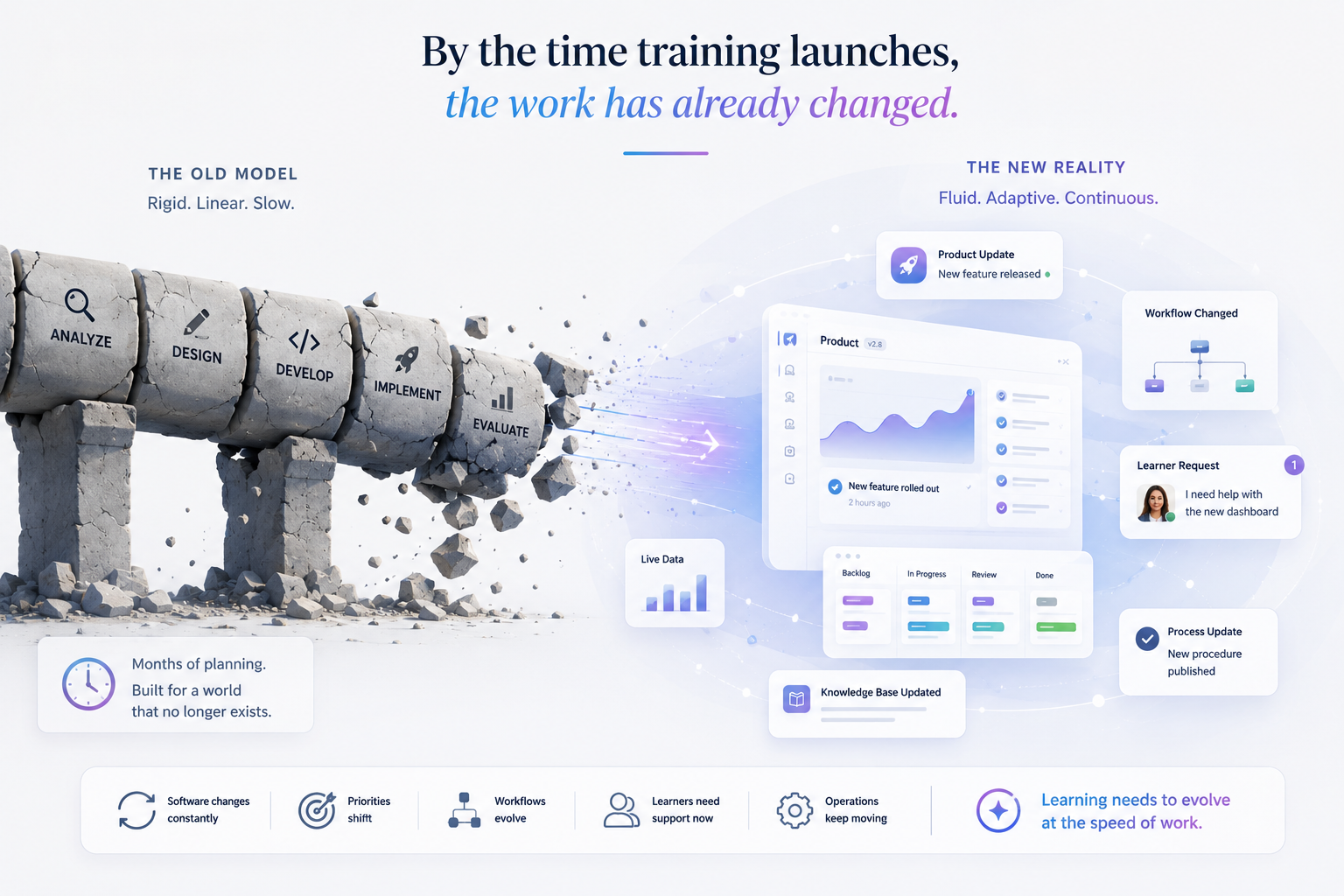
To understand why Agile learning development has become so important, it helps to examine the limitations of more traditional approaches. Many learning teams still operate heavily within a waterfall-style development structure commonly associated with frameworks like ADDIE. This process can work extremely well in environments where requirements remain stable and timelines are predictable. However, modern organizations increasingly operate in conditions where change is constant.
By the time a large-scale training program is fully developed:
Software may already look different
Business priorities may have shifted
Workflows may have changed
Learners may already require immediate support
Operational procedures may have evolved
This creates one of the most common frustrations in modern L&D environments: training programs that feel outdated almost immediately after launch.
Agile learning development emerged largely as a response to this challenge.
Instead of spending months creating large training programs before release, Agile teams focus on supporting learners in real time while continuously improving the learning experience as needs evolve.
How Agile Learning Development Works in Practice
To better understand Agile learning development, imagine a software company that releases new product updates every two weeks.
A traditional training approach might attempt to create:
Full eLearning modules
Comprehensive facilitator guides
Assessments
Job aids
Certification programs
Formal documentation
…before learners receive any support at all.
An Agile learning team would take a very different approach. Rather than waiting for an entire curriculum to be completed, the team may quickly release:
A short walkthrough video
A quick-reference guide
A searchable knowledge article
A brief microlearning module
A virtual Q&A session
A lightweight software simulation
These resources provide immediate learner support while larger learning solutions continue to evolve. As learner feedback and operational data are collected, the training becomes more sophisticated. Additional iterations may include:
Scenario-based learning
Advanced simulations
Role-specific learning paths
Enhanced assessments
Coaching tools
Certification systems
Analytics-informed improvements
The learning solution is never truly “finished.” It continuously grows alongside the organization itself.
The Core Principles Behind Agile Learning Development
Although Agile approaches vary across organizations, several core principles consistently shape Agile learning environments.
Iterative Development
One of the defining characteristics of Agile learning development is iteration. Instead of building an entire training ecosystem upfront, Agile teams develop learning incrementally. Smaller learning assets are released earlier, evaluated in real-world environments, and improved continuously over time. This allows organizations to respond to learner needs much faster while reducing the risk of investing enormous amounts of time into training that may quickly become outdated. Iteration also creates flexibility. Teams can adjust priorities as business conditions change rather than feeling locked into a rigid development plan created months earlier.
Continuous Collaboration
Agile learning development depends heavily on collaboration across teams and departments.
Traditional development models often involve lengthy handoffs between departments:
SMEs provide information
Designers build the course
Reviewers provide feedback
Trainers deliver the content
Agile environments are typically far more integrated.
Instructional designers, SMEs, operations leaders, software teams, project managers, facilitators, and stakeholders collaborate continuously throughout development. This creates faster communication, stronger alignment, and more accurate learning experiences.
Collaboration becomes an ongoing process rather than a single phase within the project lifecycle.
Rapid Feedback Loops
In Agile learning development, feedback is not treated as something collected only after implementation.
Instead, learner feedback, analytics, operational data, stakeholder insights, and performance metrics continuously shape the development process.
Agile teams regularly ask:
Where are learners struggling?
What support resources are being used most?
Which workflows continue to create confusion?
What questions are repeatedly appearing?
What operational outcomes are improving?
Which learning assets are ineffective?
This constant evaluation allows learning solutions to evolve based on actual learner behavior rather than assumptions made during initial planning.
Adaptability and Responsiveness
Perhaps the most important mindset shift in Agile learning development is the acceptance of change.
Traditional models often treat changing requirements as disruptions to the project plan. Agile environments assume change will happen from the beginning.
This creates a more adaptive development culture where learning teams can respond quickly to:
Organizational changes
New technologies
Operational shifts
Emerging learner needs
Updated workflows
Business priorities
Adaptability is not viewed as a sign of poor planning. It is viewed as a necessary capability in modern business environments.
Agile Learning Development and the Evolution of the Learning Professional
As Agile learning development becomes more common, the role of the learning professional is evolving as well.
Modern L&D professionals are no longer simply course developers working independently behind the scenes. Increasingly, they function as:
Learning strategists
Performance consultants
Business partners
Systems thinkers
Experience designers
Learning ecosystem architects
This shift requires new ways of thinking about learning development. Success in Agile environments often depends on the ability to:
Work collaboratively across departments
Prioritize learner performance needs
Operate comfortably within ambiguity
Develop rapidly without sacrificing quality
Analyze learner data continuously
Adapt to evolving operational realities
The learning professional becomes deeply integrated into the operational rhythm of the organization itself.
Common Agile Frameworks Used in Learning and Development
Several Agile-inspired frameworks are commonly applied within L&D environments.
Scrum
Scrum organizes work into short development cycles called “sprints,” typically lasting between one and four weeks. During each sprint, teams focus on completing a defined set of priorities before reviewing progress, gathering feedback, and planning the next iteration. This structure works particularly well in environments where learning content must evolve quickly alongside products or operational changes.
Kanban
Kanban focuses on visual workflow management and continuous task flow. Work is typically organized into stages such as:
Backlog
In Progress
Review
Completed
Kanban systems help teams visualize workload, identify bottlenecks, and improve operational efficiency. Many L&D departments naturally use Kanban-style workflows even if they do not formally label them as Agile.
SAM (Successive Approximation Model)
SAM is one of the most commonly used Agile-aligned instructional design models. Unlike traditional linear development models, SAM emphasizes:
Rapid prototyping
Continuous feedback
Iterative revisions
Frequent collaboration
Rather than spending months designing a complete course before development begins, teams create prototypes early, review them frequently, and refine them continuously.
The process often resembles:
Prototype → Review → Revise → Expand
This approach aligns particularly well with fast-moving learning environments where requirements evolve throughout the project lifecycle.
A Common Misunderstanding About Agile Learning Development
One of the biggest misconceptions surrounding Agile learning development is the belief that Agile simply means “creating training faster.” This is not entirely accurate. Poorly implemented Agile environments can absolutely become chaotic “speed-first” cultures where quality suffers. However, true Agile learning development still values:
Strong instructional design principles
Learning science
Accessibility
User experience
Evaluation
Governance
Performance outcomes
The difference is not the removal of quality standards. The difference is the timing and structure of development. Rather than attempting to perfect everything before release, Agile teams prioritize responsiveness, learner support, and continuous improvement over long development cycles. High-quality Agile learning development still requires thoughtful instructional design. It simply approaches development through a more adaptive lens.
The Growing Importance of Agile Learning Development
As organizations continue to evolve more rapidly, Agile learning development will likely become increasingly important across the Talent Development field. Businesses now expect learning teams to:
Respond quickly to operational change
Support ongoing digital transformation
Enable workforce readiness rapidly
Improve learning continuously
Align learning directly with business performance
This is especially true in environments such as:
SaaS organizations
Customer education
Technical onboarding
Product enablement
Operations training
Sales enablement
Leadership development
Enterprise systems training
In these environments, learning can no longer function as a slow-moving support department disconnected from operational reality. Learning must evolve at the speed of the business itself. Agile learning development provides a framework for making that possible.
Final Thoughts
Agile learning development represents more than just a project management methodology. It reflects a larger transformation happening across the learning industry. Modern learning environments increasingly require:
Continuous adaptation
Faster responsiveness
Cross-functional collaboration
Data-informed decision making
Learner-centered design
Ongoing iteration
For Talent Development professionals, understanding Agile principles is becoming less of a specialized skill and more of a foundational capability for operating effectively in modern organizations. The future of learning is unlikely to belong to rigid, isolated development processes. It will belong to learning ecosystems capable of evolving continuously alongside the people, systems, and organizations they are designed to support.
Explore More Articles