The Needs Assessment Meeting No One Talks About
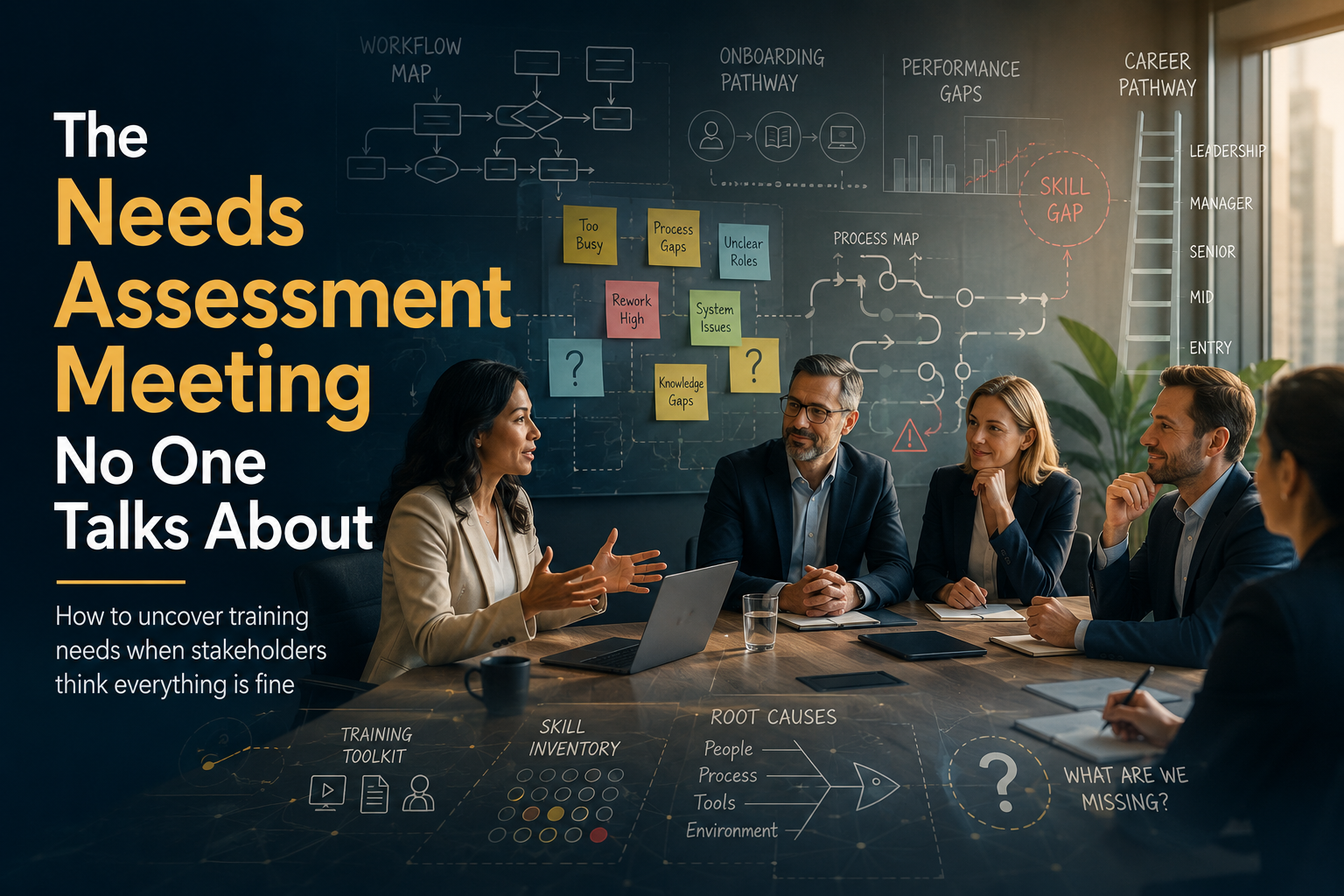
How to uncover training needs when stakeholders think everything is fine
Earlier in my career, I stepped into an organization as its first instructional designer and began meeting with leaders across departments to understand how training could support their teams. What I found was not resistance, but unfamiliarity. Many leaders had never been asked to look at their department through a learning and performance lens. They understood the work deeply, but they did not always have a clear way to translate that knowledge into training needs, onboarding priorities, role expectations, or career development structures. That experience changed the way I approached needs assessment. I learned that L&D cannot always wait for stakeholders to name the problem. Sometimes we have to help make the problem visible first.
Introduction: The Meeting No One Prepares You For
Most needs assessment advice begins with a convenient assumption: someone has already recognized a problem. A stakeholder notices that employees are making mistakes, customers are confused, onboarding is taking too long, performance is inconsistent, or business goals are not being met. They reach out to Learning and Development and say, “We need training.” From there, the process is familiar. L&D clarifies the performance gap, identifies the audience, defines the desired outcome, and recommends a solution.
But that version of the needs assessment meeting only describes one kind of situation. In many organizations, especially organizations without mature training structures, L&D may not be called in because someone has already identified a problem. L&D may be the one initiating the conversation because something appears inconsistent, undocumented, unclear, or overly dependent on a few experienced employees.
This is the needs assessment meeting no one talks about: the meeting no one asked for yet.
It is the conversation where a leader may say, “Everything is fine,” while new employees are learning mostly through shadowing and trial and error. It is the conversation where there may be no clear onboarding standards, no defined career pathway, no shared criteria for proficiency, and no consistent way to determine whether someone is ready for the next level. It is the conversation where the department may be functioning, but the structure behind the work is thin, informal, or invisible.
That changes the role of L&D. The goal is not to walk in and prove that something is broken. The goal is to make the work visible enough that hidden needs can be recognized, discussed, and addressed.
When “Everything Is Fine” Hides the Real Need
When stakeholders say everything is fine, they may not be resisting the conversation. They may simply be describing the department from the perspective they are used to seeing. Work is getting done. Customers are being served. Employees are asking questions when they need help. Experienced team members are stepping in. The operation is moving.
But functioning is not the same as structured. Work getting done is not the same as work being repeatable. Experienced employees filling gaps is not the same as having a sustainable learning process.
In low-structure environments, training needs often become part of the background. New employees “pick things up over time.” High performers become the people everyone goes to for answers. Managers make promotion decisions based on instinct because no one has clearly defined what readiness looks like. Processes exist, but they may change depending on who is performing the work. Important knowledge lives in people’s heads instead of in systems, documents, job aids, or structured learning experiences.
These issues may not feel urgent because they have become normal. The organization may not see a training problem because the cost is being absorbed quietly through rework, repeated explanations, slow ramp-up, inconsistent performance, unnecessary escalation, or dependency on a few key people.
This is where L&D has to look beneath the surface. The stakeholder may not be able to name the issue yet, but the work may already be showing signs of a hidden need.
Start With the Work, Not the Training
In this kind of meeting, “What training do you need?” is usually the wrong first question. It assumes the stakeholder already understands the gap and knows training is the right answer. In a less mature environment, that may not be true. The stakeholder may ask for a course that does not solve the real problem, or they may say they do not need training at all because the real issue has never been formally named.
A stronger starting point is the work itself. Before L&D can recommend training, documentation, job aids, coaching, assessments, or career pathways, it needs to understand what employees are actually expected to do.
What does the role involve?
What does successful performance look like?
What decisions does the employee need to make?
What tools, systems, processes, customers, or departments does the role interact with?
What happens when the work is done incorrectly? Who is affected downstream?
These questions are useful because they do not require the stakeholder to admit there is a problem. They simply ask the stakeholder to describe reality. That makes the conversation feel less like an audit and more like discovery.
The work is always the best starting point because once the work becomes visible, the learning need becomes easier to identify. A task that requires consistent execution may need a standard operating procedure, checklist, job aid, or guided practice. A task that requires judgment may need scenarios, coaching, and decision-making practice. A task that requires technical accuracy may need demonstration, repetition, and assessment. A role with unclear progression may need a competency framework or career pathway before a formal training program can be designed.
This is one of the most important shifts L&D can make: do not begin with content. Begin with performance.
Turn Vague Language Into Observable Behavior
Stakeholders often describe needs using broad labels. They may say employees need better communication, stronger ownership, more product knowledge, better judgment, leadership skills, professionalism, accountability, or technical understanding. These phrases may be true, but they are not specific enough to design from.
The work of L&D is to turn those labels into observable behavior.
If a stakeholder says employees need better communication, the next question is not, “Should we create a communication course?” The better question is, “What should they be able to communicate, to whom, and in what situations?”
If the stakeholder says employees need more product knowledge, the follow-up is, “What should they be able to explain, recognize, troubleshoot, or decide without help?”
If the stakeholder says employees need more ownership, the next step is to ask what ownership would look like in a real situation.
That is how vague expectations become usable performance requirements.
This matters because a training solution is only as strong as the clarity behind it. “Improve communication” is too broad. “Send accurate handoff notes to the support team before the end of each shift so open issues can be resolved without repeated follow-up” is something L&D can build around. “Understand the system” is too vague. “Identify the most common configuration errors, explain their impact, and correct them using the approved process” is much stronger.
This same principle is critical when building career pathways. Career progression cannot be based only on time in role or a manager’s general sense that someone is ready. It needs to be tied to increasing capability. As someone moves from beginner to intermediate to advanced, what changes? Do they handle more complex work? Do they need less supervision? Do they troubleshoot more difficult issues? Do they communicate with more stakeholders? Do they mentor others? Do they make better decisions under pressure?
Those answers become the raw material for role levels, competencies, assessments, learning paths, and promotion criteria.
Listen for Hidden Clues
Some of the most valuable information in a needs assessment meeting will not come from direct answers. It will come from the casual comments stakeholders make along the way.
When someone says, “They usually just ask Sarah,” that may mean Sarah has become the unofficial knowledge base. When someone says, “They pick that up over time,” that may mean there is no intentional path to proficiency. When someone says, “It depends who trains them,” that may mean onboarding is inconsistent. When someone says, “Everyone does it a little differently,” that may mean there are no shared standards. When someone says, “They should already know that,” that may mean expectations are implied but not taught.
These phrases are easy to miss because they sound ordinary. But they often point directly to the hidden structure L&D needs to uncover.
The key is to slow down and ask the next useful question. If people usually ask Sarah, what do they ask her? How did Sarah learn it? Should more people be able to do that? What would happen if Sarah were unavailable? If everyone does the process differently, which differences matter? Which differences create errors, delays, or customer confusion? If people are expected to learn something over time, what should they understand after 30 days, 60 days, or 90 days?
This type of questioning keeps the conversation grounded in the work. It also prevents the conversation from becoming defensive. You are not telling the stakeholder, “This is a problem.” You are asking questions that help both of you understand whether the current approach is sustainable.
Dig Through Comparison, Not Accusation
Stakeholders may not always be able to define good performance clearly, especially if the organization has never formally documented expectations for the role. But most leaders can compare performance. They can think of someone who excels and someone who struggled. That comparison is often where the clearest information emerges.
Instead of asking, “What are the competencies for this role?” ask the stakeholder to think about someone who performs the role extremely well. What does that person do differently? What do they notice that others miss? What do they handle independently? What do other employees go to them for? Then ask about someone who struggled. Where did that person get stuck? What did they need repeated? What mistakes or misunderstandings showed up more than once?
This approach is effective because it turns abstract performance into visible behavior. It also helps identify what separates basic task completion from true proficiency. The difference between an average performer and a high performer often reveals the very capabilities that should be taught, practiced, documented, or assessed.
Comparison also uncovers informal expertise. In many departments, the strongest employees are quietly holding the system together. They know the exceptions, shortcuts, risks, customer expectations, technical details, and unwritten rules. They may not think of themselves as part of the training process, but in practice, they often are.
If the department depends on them too heavily, L&D has found an important need. Not necessarily a course, but a need to capture, structure, and distribute knowledge more intentionally.
Equip Yourself Before the Meeting
If L&D is initiating the conversation, preparation matters. You do not need to enter the meeting with all the answers, but you should enter with enough context to ask informed questions.
Before the meeting, review whatever information is available. Look at job descriptions, onboarding materials, existing training, standard operating procedures, checklists, knowledge base articles, support tickets, customer feedback, quality reports, performance review forms, promotion criteria, project notes, internal messages, and work samples. The goal is not to find perfect documentation. In fact, the gaps are often the point. The goal is to notice patterns before the conversation begins.
Those patterns help L&D ask stronger questions. Instead of asking, “Do you have documentation?” it is more useful to say, “I saw that there is a checklist for this part of the process, but I did not see anything that explains how employees should handle exceptions. How do they learn that today?” Instead of asking, “Is onboarding working?” it may be more useful to say, “I noticed the onboarding materials cover the basic steps, but I am trying to understand how new employees learn the judgment-based parts of the role. Where does that usually happen?”
External research can also strengthen the conversation. Reviewing similar job postings, industry role descriptions, vendor documentation, certification outlines, professional association resources, public career ladders, and communities of practice can help L&D understand what a more mature version of the role might include. The goal is not to copy another organization’s structure. The goal is to sharpen the questions.
If similar roles commonly include troubleshooting, documentation, customer communication, escalation judgment, and mentoring, but those expectations are not clearly defined internally, that gives L&D something useful to explore.
Use a Working Hypothesis, Not a Final Answer
A good stakeholder meeting should not begin with a fixed conclusion. At the same time, L&D does not have to walk in with a blank mind. The best approach is to bring a working hypothesis.
A working hypothesis is a thoughtful starting point based on what you have observed so far. You may suspect that onboarding is inconsistent, that advanced knowledge is concentrated among a few people, that role progression is unclear, or that employees are relying heavily on shadowing instead of structured practice. The important thing is to hold that hypothesis lightly. It should guide your discovery, not turn into something you are trying to prove.
For example, you might say, “I am still learning how the department operates, but one thing I am trying to understand is how employees move from new to independent to advanced. I would like to ask a few questions about what that progression currently looks like.”
That wording keeps the conversation collaborative. It does not accuse the stakeholder of having a problem. It invites them to clarify how the work currently functions.
This is especially important when no one has asked for training yet. The tone of the meeting matters. If L&D appears to be inspecting the department, stakeholders may become guarded. If L&D appears to be learning the work so the organization can support employees more effectively, the conversation is more likely to open up.
Go Beyond the Stakeholder Interview
Stakeholder interviews are important, but they are only one source of information. If L&D relies only on one leader’s perspective, it may miss the daily reality of the role.
To understand the real need, gather multiple perspectives. Talk to leaders, but also talk to high performers, newer employees, employees who recently moved into the role, managers, adjacent departments, and people who receive the output of the work. Each group sees something different. High performers know what the job really requires. Newer employees know what was confusing. Adjacent departments know where handoffs break down. Managers know what they correct, approve, repeat, and rescue.
Observation is equally important. Watching someone perform the work often reveals steps, decisions, shortcuts, workarounds, and pain points that people forget to mention because the work has become automatic. During observation, pay attention to where someone pauses, checks notes, asks for help, relies on memory, makes a judgment call, or uses an undocumented workaround.
This is how L&D moves from what people say happens to what actually happens. That distinction matters. Training built only from stakeholder perception may miss the real conditions of the job. Training built from interviews, observation, artifacts, and evidence is much more likely to address the actual need.
Use Draft-and-Validate to Build Structure
In low-structure organizations, stakeholders may struggle to create a training plan, competency model, or career pathway from a blank page. That does not mean they are unwilling to help. It may simply mean they have never been asked to define the work that way before.
This is where draft-and-validate becomes useful.
After gathering information through conversations, observation, artifacts, and research, L&D can create a rough version of what it is seeing. That might be a draft role progression, a list of core tasks, a proposed onboarding sequence, a preliminary competency model, or a map of where knowledge currently lives. Then L&D can bring that draft back to stakeholders and ask them to validate it.
Instead of asking, “What should the career pathway be?” L&D can say, “Based on what I have heard so far, I am seeing three levels of progression: foundational, independent, and advanced. I would like to validate whether that reflects the role accurately.”
Instead of asking, “What training should new employees receive?” L&D can say, “Here is the sequence I am currently seeing: basic system navigation, guided practice with common tasks, troubleshooting scenarios, and supervised exposure to exceptions. What would you change?”
Many stakeholders are much better at responding to a draft than creating structure from nothing. A draft gives them something concrete to agree with, challenge, refine, or correct. It also helps move the organization from informal knowledge to shared language.
That shared language is often the first real step toward a stronger learning ecosystem.
The First Meeting Is Only the Beginning
The first meeting does not need to solve everything. It should not be expected to produce a complete course outline, finalized competency framework, or fully defined career pathway.
The purpose of the first meeting is to open the investigation.
By the end of the conversation, L&D should have a clearer understanding of the role, the work, the expectations, the risks, the informal knowledge, the available evidence, and the people who need to be consulted next. L&D should also have a better sense of whether the solution is likely to involve training, documentation, coaching, job aids, assessment, process improvement, clearer role definitions, or some combination of those supports.
That is a successful first meeting.
In mature organizations, needs assessment may begin with a clearly named problem. In less mature organizations, needs assessment often begins with hidden structure. L&D has to find the expectations before it can build the learning path. It has to understand the work before it can define proficiency. It has to uncover the informal standards before it can formalize them. It has to identify where knowledge lives before it can make that knowledge accessible.
That is why L&D cannot always wait to be invited in.
Sometimes the most important needs assessment meeting is the one no one asked for yet.
A Practical Tool for the Conversation
These conversations can get complex quickly. You may walk into the meeting expecting to discuss training and end up uncovering unclear role expectations, undocumented processes, inconsistent onboarding, repeated questions, or career pathway gaps. A structured tool helps keep the conversation focused without turning it into an interrogation.
The companion worksheet is designed to help you prepare before the meeting, guide the discussion, capture what you hear, and organize the evidence afterward. It gives you space to document stakeholder insights, follow-up questions, possible performance gaps, evidence sources, and next steps, so you are not trying to hold every question or observation in your head while the conversation is happening.
This is especially useful when stakeholders do not already have a clear problem to hand you. Instead of relying on assumptions or scattered notes, you can use the worksheet to move from vague statements to specific observations, from individual opinions to evidence, and from a general sense that “something is missing” to a clearer picture of where training, documentation, coaching, process support, or career pathway development may be needed.
Final Thought: Make the Work Visible
When stakeholders think everything is fine, L&D does not need to argue. It needs to investigate.
Ask what people do. Ask what good performance looks like. Ask what goes wrong. Ask what gets repeated. Ask what lives in people’s heads. Ask what only the strongest employees know. Ask what someone should be able to do before they are trusted with more.
The hidden training need is often found in the space between “this is how we have always done it” and “this is what people actually need to perform well.”
That is where L&D creates real value. Not by taking orders. Not by forcing training into every gap. Not by waiting until a problem becomes obvious enough that someone finally asks for help.
But by making the work visible, turning informal expectations into clear standards, and building the learning structure the organization did not yet know it needed.
Explore More Articles