The Four Pillars of AI in Learning & Development
A framework developed by Amanda Lynn
Artificial intelligence is rapidly transforming Learning & Development, but conversations about AI often focus on a single use case—content creation. While AI can certainly accelerate course development, its impact extends far beyond instructional design workflows.
To fully understand AI's role in modern Learning & Development, we need a broader framework.
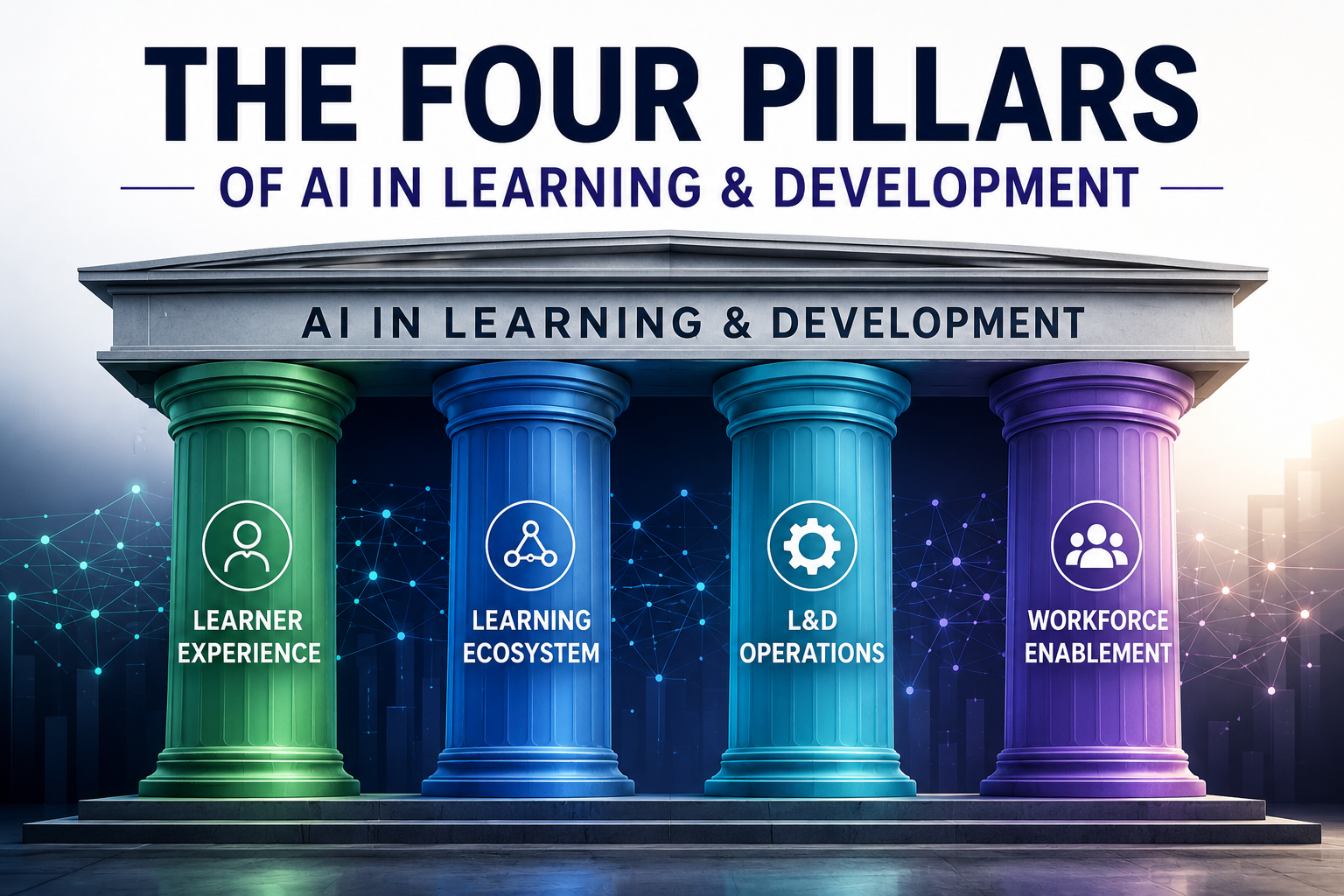
The Four Pillars of AI in Learning & Development provide a practical way to understand where AI creates value across the learning landscape. Rather than viewing AI as a single tool or capability, this framework recognizes four interconnected areas where AI supports learners, learning teams, and organizations.
Pillar 1: Learner Experience
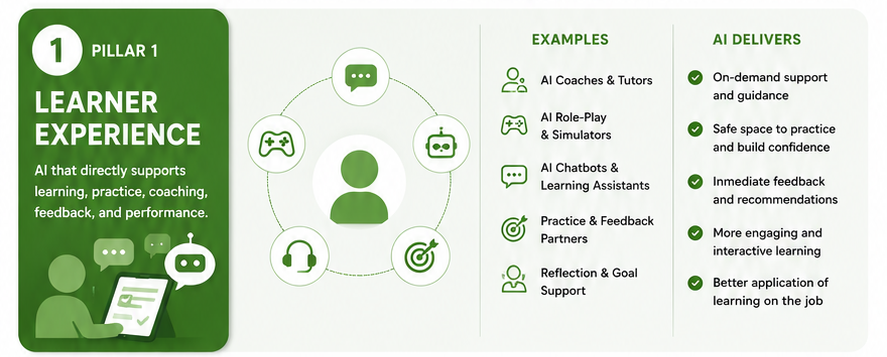
The first pillar focuses on AI that learners interact with directly.
This includes AI-powered coaches, tutors, role-play simulators, chatbots, learning assistants, and feedback tools. These solutions provide learners with support, practice opportunities, and guidance when instructors, managers, or subject matter experts are not immediately available.
AI can create more personalized and accessible learning experiences by helping learners practice skills, receive feedback, reflect on decisions, and access support in the flow of work.
Examples include:
AI coaches and tutors
AI role-play and simulation experiences
Learning assistants and chatbots
Practice and feedback partners
Reflection and goal-support tools
The primary outcome of this pillar is improved learner support, engagement, confidence, and performance.
Pillar 2: Learning Ecosystem
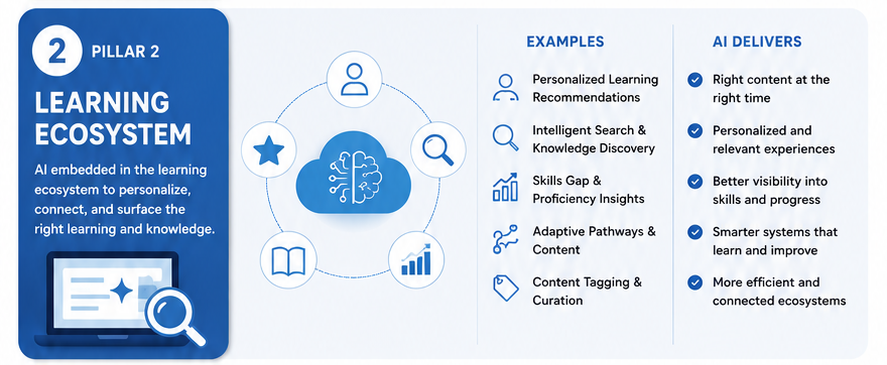
The second pillar focuses on AI embedded within learning systems and platforms.
Unlike learner-facing tools, this AI often operates behind the scenes. Its purpose is to connect learners with the right content, resources, and development opportunities at the right time.
AI can enhance learning ecosystems by improving search capabilities, recommending content, identifying skill gaps, supporting adaptive learning pathways, and organizing knowledge more effectively.
Examples include:
Personalized learning recommendations
Intelligent search and knowledge discovery
Skills and proficiency insights
Adaptive learning pathways
Automated content tagging and curation
The primary outcome of this pillar is a more connected, personalized, and efficient learning environment.
Pillar 3: L&D Operations
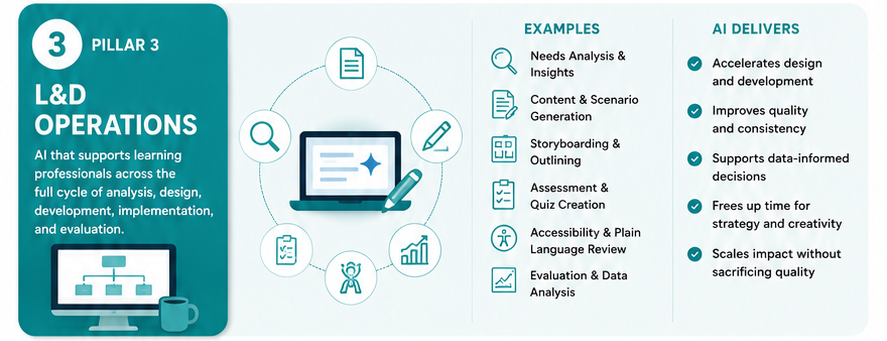
The third pillar focuses on how AI supports Learning & Development professionals.
AI can act as a design and productivity partner throughout the learning lifecycle. From needs analysis to evaluation, AI can help learning teams work more efficiently while maintaining instructional quality and strategic focus.
This pillar is where many organizations begin their AI journey, using AI to accelerate content creation, streamline workflows, and reduce administrative effort.
Examples include:
Needs analysis and data synthesis
Content and scenario generation
Storyboarding and outlining
Assessment development
Accessibility and quality review
Evaluation and learning analytics
The primary outcome of this pillar is faster development, increased efficiency, and more time for strategic work.
Pillar 4: Workforce Enablement
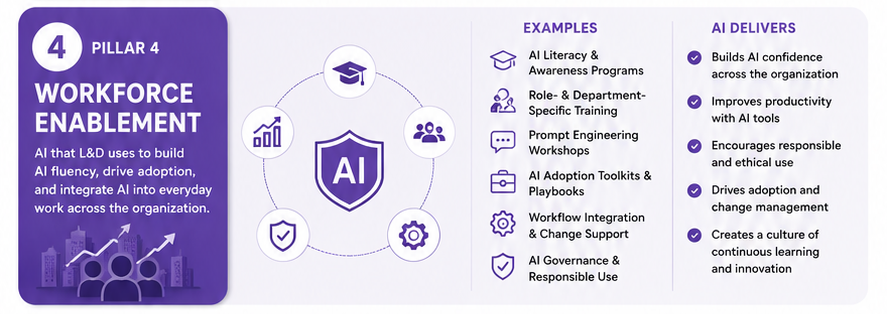
The fourth pillar expands beyond Learning & Development and focuses on enabling the broader workforce to use AI effectively.
As organizations adopt AI technologies, Learning & Development plays a critical role in helping employees build AI literacy, understand responsible use, and integrate AI into their daily workflows.
This pillar positions L&D as a strategic partner in organizational transformation rather than solely a provider of training.
Examples include:
AI literacy and awareness programs
Role-specific AI training
Prompt engineering workshops
AI adoption toolkits and playbooks
Workflow integration support
AI governance and responsible-use education
The primary outcome of this pillar is a workforce that can confidently and responsibly leverage AI to improve performance and productivity.
Interactive GPT Practice Coach
Practice Applying the Framework
Try The Four Pillars AI Coach, a custom GPT that helps learning professionals apply the framework to realistic enterprise AI scenarios.
Classify primary and secondary pillars, explain your reasoning, and receive coaching-oriented feedback designed to build strategic AI judgment.
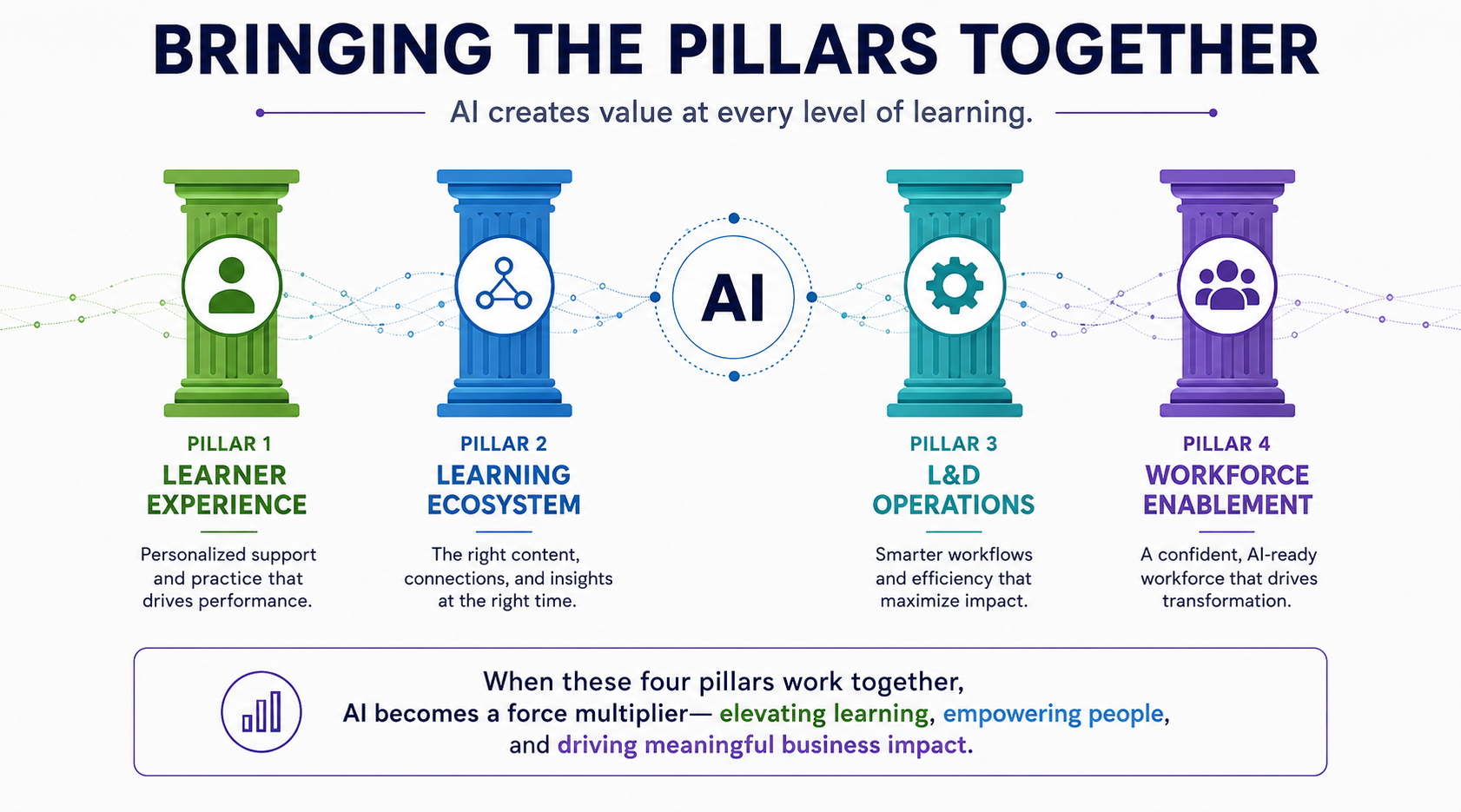
Practice the FrameworkBringing the Pillars Together
The true power of AI in Learning & Development emerges when these four pillars work together.
Learners receive personalized support and practice opportunities. Learning ecosystems become more intelligent and responsive. Learning teams operate more efficiently and strategically. Organizations build the skills and confidence needed to adopt AI responsibly.
Viewed through this lens, AI is not simply a content-generation tool. It is a transformative capability that can enhance learner experiences, strengthen learning ecosystems, empower L&D operations, and enable workforce transformation.
By understanding AI through these four pillars, Learning & Development professionals can make more intentional decisions about where to invest, experiment, and create value.
Explore More Articles