Walking Into Ambiguity: How a Training Professional Builds the First Roadmap

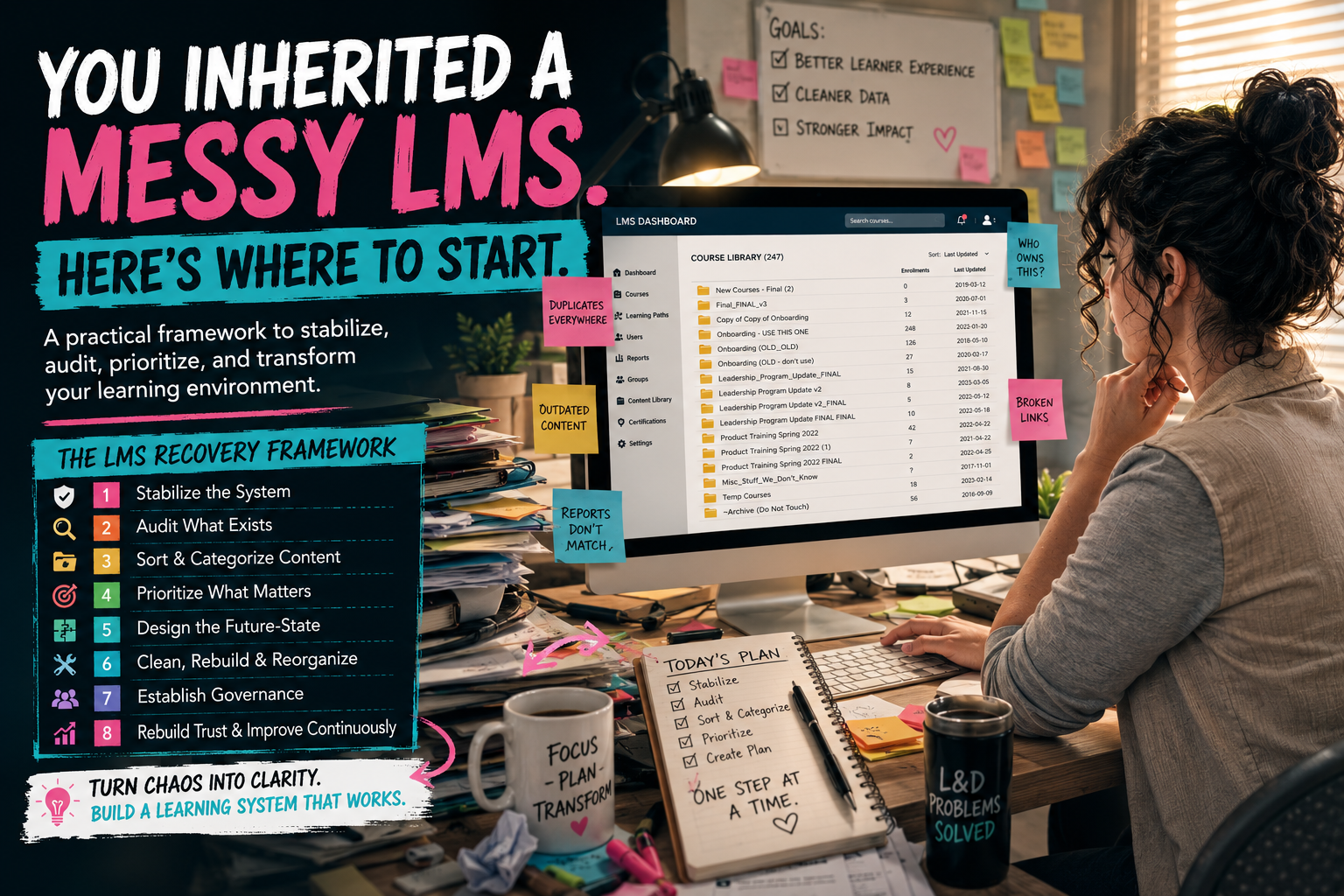
There is a unique challenge that comes with inheriting a learning function that is still being built.
Perhaps there is an LMS with a handful of courses. Perhaps there are scattered job aids, PowerPoint decks, SOPs, and training documents stored across multiple systems. There may be no formal curriculum, no governance structure, no development standards, no learning roadmap, and no shared understanding of what should be built next.
You walk into the organization carrying only what the interview process provided: a general understanding of the role, a sense of the business, and the knowledge that there is far more work to be done than can reasonably be accomplished in the first few months.
Your manager introduces you to the team. Access requests are submitted. Someone points you toward the LMS. Someone else shares a folder containing training materials accumulated over several years. Before the week is over, a stakeholder mentions a training need they would like addressed. Another asks about onboarding. A third wants to discuss a certification program. The requests arrive quickly, but the priorities do not.
The challenge facing a new Training and Development Professional is not finding work to do. Instead, the challenge is determining which work matters most. When no roadmap exists, the first responsibility is to create one.
Download the 30-60-90 Day Planning Workbook
To apply this approach, download the companion workbook. It includes stakeholder mapping prompts, a learning inventory template, needs assessment questions, a training request evaluation matrix, and a 30-60-90 day action plan for building the first roadmap.
Download the WorkbookUnderstanding the Business Before Evaluating the Training
Many learning professionals begin by reviewing courses, onboarding programs, and existing content. While this work is important, it is difficult to evaluate training in isolation from the business it serves.
Training exists to support performance, and performance exists to support business objectives.
For this reason, my first priority is developing a working understanding of the organization itself. Before asking what employees need to learn, I want to understand what the business needs employees to accomplish.
During the first few weeks, I focus on questions such as:
How does the organization create value?
What strategic objectives are driving decisions this year?
Which departments are most critical to success?
Which roles are difficult to hire, train, or retain?
Where do operational, safety, compliance, or customer risks exist?
What metrics matter most to leadership?
These conversations rarely produce immediate training projects, but they provide something more valuable: context. Without context, every training request appears equally important. With context, priorities begin to emerge.
This is also the stage where relationships begin to form. Rather than arriving with solutions, I prefer to arrive with questions. Leaders generally know where performance challenges exist. What they need is a learning partner who can help determine whether training is part of the solution.
Identifying the Holders of Institutional Knowledge
As organizational understanding develops, attention naturally shifts toward the people who know how work actually gets done.
Every organization has formal documentation. It may include SOPs, process guides, technical manuals, onboarding materials, or knowledge repositories. Yet almost every organization also possesses a second knowledge system that exists outside formal documentation.
It resides in people.
There is usually a technician who can diagnose problems others cannot solve, a project manager who understands every exception to the process, or a long-tenured employee whom everyone calls when they need an answer.
These individuals are often some of the most important stakeholders in the organization.
They reveal where knowledge transfer risks exist. They expose gaps between documented processes and operational reality. They often possess expertise that has never been formally captured and may represent a significant organizational vulnerability if they leave.
One of the most valuable exercises during the first month is identifying these individuals and understanding the knowledge they carry. Doing so often reveals opportunities that would never appear in a training inventory alone.
Assessing the Current Learning Environment
Only after developing a foundational understanding of the business and its people do I begin conducting a structured assessment of the learning ecosystem.
The goal is not to critique what exists. The goal is to understand it.
This assessment typically includes reviewing:
LMS content
New hire onboarding programs
Compliance and safety training
Technical training materials
Job aids and SOPs
Instructor-led programs
Certifications
Knowledge bases
Department-specific resources
As resources are gathered, I begin building an inventory. For each asset, I document its audience, purpose, owner, format, current status, and last known update.
The exercise is deceptively simple, but it often reveals important patterns. Some topics may have multiple overlapping resources while others have none. Certain departments may have invested heavily in training while others rely almost entirely on informal coaching. Content may exist, but ownership may be unclear. Resources may be valuable, but employees may not know where to find them.
Before priorities can be established, visibility must exist. A learning inventory creates that visibility.
Distinguishing Requests from Needs
As stakeholders become aware of the new learning resource available to them, requests inevitably begin to arrive.
Some requests are straightforward. Others are not.
A leader may request a course, ask for additional onboarding, or suggest a new certification program. While these requests are useful sources of information, they should not automatically become projects.
A training request is not the same thing as a learning need.
More often than not, a training request is a symptom of a broader challenge. The challenge may involve knowledge, skill, communication, process design, documentation, leadership reinforcement, or some combination of factors.
This distinction is one of the most important responsibilities of a learning professional.
Rather than asking stakeholders what training they want, I prefer to understand the performance challenge they are trying to solve. Conversations often include questions such as:
What is happening today that should not be happening?
What should employees be doing differently?
What mistakes occur most frequently?
What takes new employees longest to learn?
What distinguishes high performers from average performers?
What happens if this issue is not addressed?
The answers help move the discussion away from solutions and toward root causes.
Only after the problem is clearly understood does it become possible to determine whether training is the appropriate response.
Establishing Priorities in an Environment of Unlimited Demand
By this point, the challenge is rarely a lack of opportunities.
The challenge is deciding where to focus.
Every learning function eventually encounters the same reality: there will always be more requests than available time, budget, and resources. Without a structured approach to prioritization, the roadmap becomes reactive. The loudest voice receives attention first, while more important initiatives wait quietly in the background.
To avoid this, I evaluate potential initiatives through several lenses:
Business impact
Safety implications
Compliance requirements
Operational risk
Workforce reach
Executive priorities
Development effort
Strategic alignment
Not every request deserves immediate action. Some initiatives carry significant organizational consequences while others can reasonably wait.
The purpose of prioritization is not to deny requests. It is to direct resources toward the areas where they can create the greatest value.
Once priorities are established, the learning function begins to shift from responding to requests toward guiding organizational capability development.
Creating the Conditions for Sustainable Growth
As priorities become clearer, many organizations naturally want to accelerate development. This is understandable. Stakeholders have identified needs, opportunities have been uncovered, and momentum is beginning to build.
Yet before large-scale development begins, another foundation must be established.
Learning functions require structure if they are to scale effectively.
This often includes:
A project intake process
Development standards
Governance practices
Content ownership guidelines
Review and update cycles
Evaluation methods
Reporting mechanisms
LMS standards
These systems may not be as visible as a new course launch, but they determine whether the learning function can operate consistently over time.
A strong learning ecosystem is not simply a collection of training programs. It is a collection of systems that ensure training remains accurate, accessible, measurable, and aligned with business needs.
Building the First Roadmap
Eventually, a turning point arrives.
The business has been studied. Stakeholders have been interviewed. Institutional knowledge has been identified. Existing resources have been assessed. Performance challenges have been documented. Priorities have begun to emerge.
For the first time, it becomes possible to see the learning function as a whole.
This is where the roadmap is built.
The roadmap should answer a series of practical questions:
What capabilities must the organization strengthen?
Which audiences require the greatest support?
Which initiatives should be addressed first?
Which projects can wait?
What resources are required?
How will success be measured?
The resulting plan is more than a collection of training projects. It is a strategic view of how learning will contribute to organizational success.
Only then does development begin with confidence.
Translating Strategy into Action: A 30-60-90 Day Approach
Although every organization presents unique challenges, the first ninety days generally follow a similar progression. The work moves from understanding, to analysis, to execution.
The First 30 Days: Learn, Listen, and Inventory
The first month is dedicated to discovery. The objective is to understand the business, build relationships, and establish visibility into the current learning environment.
Key activities include:
Meeting with leaders and stakeholders
Learning business priorities and success measures
Identifying critical roles and operational risks
Reviewing existing training materials
Assessing onboarding and compliance programs
Building a training inventory
Identifying key subject matter experts
The primary deliverables during this phase are an understanding of the business, a stakeholder map, and a documented view of the current learning landscape.
Days 31–60: Analyze, Diagnose, and Prioritize
The second month focuses on making sense of the information gathered during discovery.
During this period, the work includes:
Conducting needs assessments
Evaluating training requests
Identifying root causes behind performance challenges
Distinguishing training needs from process or communication issues
Defining prioritization criteria
Establishing governance and development standards
By the end of this phase, learning needs have been evaluated within the broader context of business objectives, and the most important opportunities for improvement have become clear.
Days 61–90: Build the Foundation
The final month is where strategy begins turning into action.
Activities typically include:
Finalizing the learning roadmap
Aligning priorities with stakeholders
Establishing learning standards and governance
Launching high-priority initiatives
Creating measurement and reporting processes
Building repeatable systems for future development
The objective is not to solve every learning challenge within ninety days. The objective is to ensure the organization leaves the first ninety days with a clear understanding of where learning is today, where it needs to go, and how it will get there.
Conclusion
When people think about learning and development, they often think about courses, workshops, and training programs. Yet the most important work at the beginning of a new role happens long before any course is developed.
It happens through observation, discovery, analysis, and prioritization.
The first roadmap is not built in an authoring tool. It is built through conversations, assessments, and a growing understanding of how the organization succeeds.
Only after that understanding exists can training be developed with confidence.
Ambiguity never completely disappears from the work of learning and development. Organizations evolve, priorities shift, and new challenges emerge. The goal is not to eliminate ambiguity. The goal is to transform it into a strategy that helps people perform, grow, and contribute to the success of the business.
That transformation is where the real work begins.
Explore More Articles